Cycloastragenol (98% HPLC) Supplier | Ultimate Guide 2026 | CQHERB
Jul 27, 2026
Cycloastragenol Ultimate Guide (2026)
Everything You Need to Know About Cycloastragenol (CAG): Benefits, Manufacturing, Specifications, Applications & Buying Guide
Author: CQHERB Technical Team
Last Updated: July 2026
Estimated Reading Time: 18 Minutes
What Is Cycloastragenol?
Cycloastragenol (CAG) is a naturally occurring cycloartane-type triterpenoid aglycone derived from Astragalus membranaceus. It is most commonly obtained through the controlled hydrolysis or biotransformation of Astragaloside IV, one of the major bioactive saponins found in Astragalus root.
Due to its extremely low natural abundance, commercial-scale Cycloastragenol is rarely produced through direct extraction. Instead, modern manufacturing relies on carefully controlled conversion technologies to achieve high purity and batch consistency.
Today, Cycloastragenol has become one of the most extensively researched compounds from Astragalus species, attracting attention in healthy aging research, nutraceutical development, cosmetic ingredient innovation, and natural product science.
Quick Answer
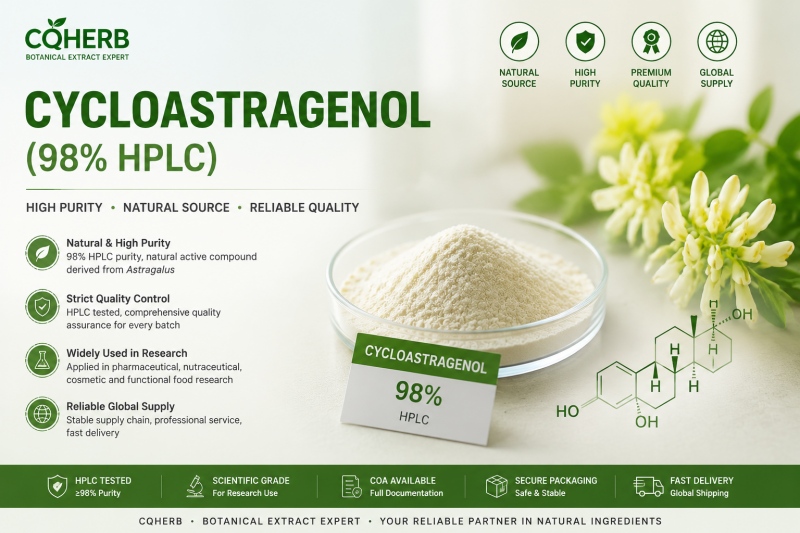
Cycloastragenol is a high-value triterpenoid compound derived from Astragalus species. Commercial products are typically manufactured by converting Astragaloside IV into Cycloastragenol through hydrolysis or biotransformation processes. High-purity Cycloastragenol (≥98% HPLC) is widely used for dietary supplement formulation, cosmetic ingredient development, and scientific research.
Key Takeaways
Cycloastragenol is a rare aglycone naturally derived from Astragalus species.
Commercial production primarily relies on Astragaloside IV conversion rather than direct extraction.
High-purity material (≥98% HPLC) is preferred for research and premium formulations.
Manufacturing technology plays a critical role in purity, impurity profile, and production cost.
Professional suppliers should provide comprehensive quality documentation, including COA, SDS, TDS, and HPLC chromatograms.
Table of Contents
What Is Cycloastragenol?
Chemical Properties
Natural Sources
Manufacturing Process
Cycloastragenol vs Astragaloside IV
Scientific Research Interest
Potential Applications
CQHERB Product Specifications
Quality Control
How to Choose a Reliable Supplier
Frequently Asked Questions
Chemical Properties
Property
Value
Product Name
Cycloastragenol
CAS No.
84605-18-5
Molecular Formula
C30H50O5
Molecular Weight
490.72
Appearance
White to Off-white Powder
Test Method
HPLC
Standard Purity
≥98% HPLC
Cycloastragenol belongs to the cycloartane triterpenoid family. Unlike Astragaloside IV, it does not contain sugar moieties, resulting in different physicochemical characteristics and formulation properties.
Natural Sources of Cycloastragenol
Cycloastragenol naturally occurs in several Astragalus species, including:
Astragalus membranaceus
Astragalus mongholicus
Although naturally present, its concentration in the plant is extremely low. Direct extraction is therefore not considered commercially practical for large-scale production.
Most high-purity Cycloastragenol available on the global market is produced through controlled conversion from Astragaloside IV.
How Is Cycloastragenol Manufactured?
Commercial Cycloastragenol production generally involves multiple controlled manufacturing steps to ensure purity and consistency.
Step 1. Extraction of Astragalus Root
Selected Astragalus roots are extracted to obtain crude saponins containing Astragaloside IV.
Step 2. Purification of Astragaloside IV
The extract undergoes multiple purification procedures to isolate high-purity Astragaloside IV.
Step 3. Hydrolysis or Biotransformation
Astragaloside IV is converted into Cycloastragenol using optimized hydrolysis or biotransformation technologies.
Step 4. Purification
The reaction product is purified through chromatographic separation and crystallization to remove impurities.
Step 5. Quality Testing
Each production batch is analyzed using HPLC and additional quality control methods before packaging.
Typical Manufacturing Flow
Astragalus Root
↓
Extraction
↓
Astragaloside IV
↓
Hydrolysis / Biotransformation
↓
Purification
↓
Crystallization
↓
Cycloastragenol
↓
HPLC Quality Control
↓
Packaging
Cycloastragenol vs Astragaloside IV
Feature
Cycloastragenol
Astragaloside IV
Compound Type
Aglycone
Glycoside
Sugar Groups
No
Yes
Molecular Weight
Lower
Higher
Manufacturing
Conversion Product
Direct Plant Component
Market Value
Higher
Lower
Purification Difficulty
High
Moderate
Although closely related, Cycloastragenol and Astragaloside IV are chemically distinct compounds with different production processes and application characteristics.
Why Has Cycloastragenol Attracted Scientific Interest?
Over the past decade, Cycloastragenol has become an active topic in natural product and healthy aging research.
Published studies have investigated its potential role in:
Telomerase-related research
Cellular senescence studies
Oxidative stress models
Immune system research
Healthy aging research
Skin biology studies
Cellular metabolism
It is important to note that much of the available evidence comes from laboratory and preclinical research. Product applications should always comply with local regulatory requirements.
Potential Applications
Dietary Supplements
Cycloastragenol is commonly formulated into:
Capsules
Tablets
Powder blends
Softgels
Functional nutrition products
Cosmetic Ingredients
Because of its botanical origin and ongoing scientific interest, Cycloastragenol has also attracted attention for cosmetic ingredient development, including:
Anti-aging serums
Facial creams
Premium skincare products
Eye care formulations
Application suitability should be evaluated according to formulation requirements and local cosmetic regulations.
CQHERB Cycloastragenol Specifications
Item
Specification
Botanical Source
Astragalus membranaceus Root
Appearance
White Powder
Assay
≥98% HPLC
Identification
HPLC
Loss on Drying
≤2.0%
Heavy Metals
Complies with Internal Specification
Residual Solvents
Controlled According to Applicable Standards
Storage
Store in a Cool, Dry Place
Shelf Life
24 Months
Quality Control
At CQHERB, each production batch undergoes comprehensive quality evaluation to ensure consistency and traceability.
Typical quality control procedures include:
HPLC Assay
Identity Verification
Heavy Metal Analysis
Residual Solvent Testing
Microbiological Testing (where applicable)
Stability Evaluation
Batch Traceability
Supporting documentation may include:
Certificate of Analysis (COA)
Technical Data Sheet (TDS)
Safety Data Sheet (SDS/MSDS)
HPLC Chromatogram
Production Flow Chart
Buyer Checklist: How to Select a Reliable Cycloastragenol Supplier
When sourcing Cycloastragenol, buyers should consider several important factors:
Is the manufacturing route clearly described?
Is the product tested by HPLC?
Are chromatograms available?
Is batch consistency maintained?
Can the supplier provide COA, TDS, and SDS?
Does the supplier have experience serving international B2B customers?
Is technical support available for formulation and documentation?
Selecting a supplier with transparent manufacturing processes and complete quality documentation can help reduce sourcing risks and support long-term product development.
Why Choose CQHERB?
CQHERB specializes in high-purity botanical active ingredients for the global nutraceutical, cosmetic, and pharmaceutical industries.
Our strengths include:
Professional botanical extract manufacturing
Strict batch quality control
HPLC-tested high-purity products
Complete export documentation
Technical support for international customers
Stable production capacity for long-term supply
Frequently Asked Questions
Is Cycloastragenol naturally extracted?
Cycloastragenol naturally occurs in Astragalus species; however, its concentration is extremely low. Most commercial products are manufactured by converting Astragaloside IV through controlled processing.
What purity is commonly available?
Research-grade Cycloastragenol is typically supplied at purity levels of 98% HPLC or higher.
What is the difference between Cycloastragenol and Astragaloside IV?
Astragaloside IV is a glycoside, while Cycloastragenol is its corresponding aglycone after sugar groups have been removed. They differ in chemical structure, production process, and formulation characteristics.
Which industries use Cycloastragenol?
Cycloastragenol is commonly supplied for nutraceutical development, cosmetic ingredient research, and natural product research.
What quality documents should a supplier provide?
Professional suppliers typically provide a Certificate of Analysis (COA), Technical Data Sheet (TDS), Safety Data Sheet (SDS/MSDS), HPLC chromatograms, and batch traceability documentation.
Conclusion
Cycloastragenol has become one of the most recognized high-value compounds derived from Astragalus membranaceus. As research into healthy aging, botanical bioactives, and advanced nutraceutical ingredients continues to evolve, demand for high-quality Cycloastragenol is expected to grow across global markets.
For manufacturers and product developers, selecting a supplier with robust manufacturing capabilities, transparent quality control, and complete technical documentation is essential for ensuring product consistency and regulatory compliance.
CQHERB is committed to supplying high-purity Cycloastragenol with strict quality management, comprehensive technical support, and reliable global B2B service.
Read More
 English






 IPv6 network supported