Dimethylcurcumin (ASC-J9) CAS 52328-98-0: Chemical Properties, Androgen Receptor Research, Applications & Buying Guide
Sep 24, 2026
Dimethylcurcumin (ASC-J9) CAS 52328-98-0: Chemical Properties, Androgen Receptor Research, Applications & Buying Guide
A Research-Oriented Guide to a Curcumin Analogue and Androgen Receptor Degradation Enhancer
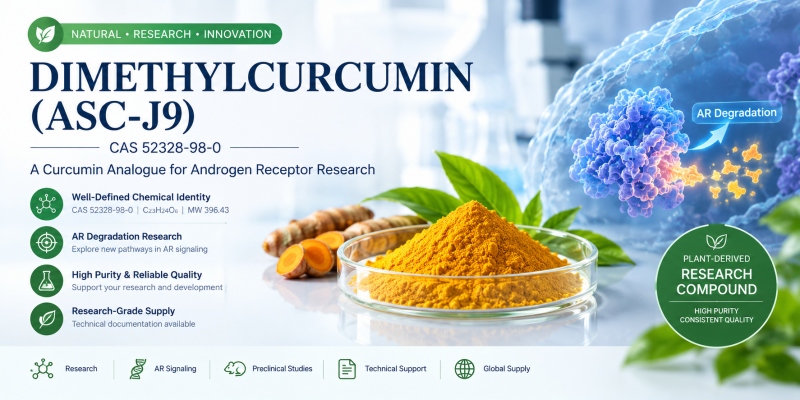
CAS No. 52328-98-0 | Molecular Formula C23H24O6 | Molecular Weight 396.43 g/mol
Quick Answer
Dimethylcurcumin, commonly known as ASC-J9 or GO-Y025, is a synthetic curcumin analogue that has been extensively investigated in laboratory and preclinical research related to androgen receptor (AR) signaling. Its chemical identity is associated with CAS No. 52328-98-0, molecular formula C23H24O6, and molecular weight 396.43 g/mol.
Unlike conventional androgen receptor antagonists that primarily interfere with androgen binding or receptor signaling, ASC-J9 has been investigated as an androgen receptor degradation enhancer. Research has examined its ability to promote degradation of androgen receptor proteins and thereby alter AR-dependent signaling in experimental models.
Published studies have investigated ASC-J9 in a range of experimental systems, including prostate cancer models, androgen receptor-associated disorders, bladder cancer models, and spinal and bulbar muscular atrophy research. These studies include in vitro cellular experiments and in vivo animal models; such findings should not be interpreted as evidence of established clinical efficacy in humans.
For researchers and organizations sourcing Dimethylcurcumin, important purchasing considerations include chemical identity, purity, analytical characterization, batch consistency, storage conditions, and supporting technical documentation.
Key Takeaways
· Dimethylcurcumin is also known as ASC-J9 and GO-Y025.
· CAS Number: 52328-98-0.
· Molecular Formula: C23H24O6.
· Molecular Weight: 396.43 g/mol.
· It is a synthetic curcumin analogue, rather than native curcumin itself.
· ASC-J9 has been investigated as an androgen receptor degradation enhancer.
· Published research has examined its effects on AR protein degradation and AR-related signaling.
· Research has included prostate cancer, bladder cancer, spinal and bulbar muscular atrophy, and other AR-associated experimental models.
· Research-grade ASC-J9 is commonly supplied as a solid/powder and may require low-temperature storage depending on the supplier's specification.
· Analytical verification is important when purchasing high-purity Dimethylcurcumin for research.
· ASC-J9 should be presented on a research-oriented website as a research compound, not as an approved therapeutic product.
1. What Is Dimethylcurcumin (ASC-J9)?
Dimethylcurcumin is a synthetic compound structurally related to curcumin and is widely known in the scientific literature as ASC-J9.
The compound is identified chemically as:
(1E,4Z,6E)-1,7-bis(3,4-dimethoxyphenyl)-5-hydroxyhepta-1,4,6-trien-3-one
Public chemical databases list Dimethylcurcumin, ASC-J9, and GO-Y025 among its synonyms. PubChem identifies CAS No. 52328-98-0 and molecular formula C23H24O6, with a molecular weight of approximately 396.4 g/mol.
Commercial research suppliers also identify ASC-J9 using the same CAS number and molecular formula and commonly describe high-purity material as a research-grade powder.
Although its name contains "curcumin," Dimethylcurcumin should not be treated as simply another commercial grade of curcumin. It is a distinct synthetic curcumin analogue with its own molecular structure and research profile.
This distinction is particularly important for purchasing, analytical testing, literature searches, and regulatory documentation.
2. Dimethylcurcumin vs. Curcumin
The relationship between Dimethylcurcumin and curcumin is an important point for researchers.
Curcumin is a naturally occurring diarylheptanoid associated with Curcuma longa. Dimethylcurcumin, by contrast, is a chemically modified analogue that contains methoxy-substituted aromatic groups and has a different molecular formula and molecular weight.
Property
Dimethylcurcumin / ASC-J9
Curcumin
Common Name
Dimethylcurcumin
Curcumin
CAS
52328-98-0
458-37-7
Formula
C23H24O6
C21H20O6
Molecular Weight
396.43 g/mol
368.38 g/mol
Relationship
Synthetic curcumin analogue
Naturally occurring curcuminoid
Research Focus
AR degradation and AR-related signaling
Broad pharmacological and biochemical research
Research Status
Experimental/research compound
Widely studied natural compound
The two compounds therefore should not be substituted for one another simply because they belong to the broader curcumin-analogue research area.
3. Chemical Identification of ASC-J9
Accurate chemical identification is particularly important for research compounds because different suppliers may use overlapping synonyms.
Core Chemical Information
Property
Information
Product Name
Dimethylcurcumin
Common Research Name
ASC-J9
Alternative Name
GO-Y025
CAS Number
52328-98-0
Molecular Formula
C23H24O6
Molecular Weight
396.43 g/mol
Chemical Class
Curcumin analogue
IUPAC Name
(1E,4Z,6E)-1,7-bis(3,4-dimethoxyphenyl)-5-hydroxyhepta-1,4,6-trien-3-one
Physical Form
Solid / powder
Research Target
Androgen receptor-related research
The identity and molecular information above are supported by PubChem and commercial analytical product records.
4. Why Is ASC-J9 Important in Research?
The scientific interest surrounding ASC-J9 largely comes from its unusual relationship with the androgen receptor.
The androgen receptor (AR) is a nuclear receptor that regulates gene transcription in response to androgen hormones. AR signaling has important physiological roles and has also been extensively investigated in diseases and biological conditions in which androgen signaling is altered.
ASC-J9 attracted research attention because studies indicated that it could promote AR protein degradation, rather than simply competing with androgens for receptor binding.
This creates an important conceptual distinction:
ASC-J9 research focuses on changing the abundance and activity of AR protein, while conventional antiandrogen research often focuses on blocking receptor activation.
Early research demonstrated that ASC-J9 could disrupt interactions between AR and selected coregulators and increase AR degradation in experimental systems.
Subsequent studies expanded this research into additional AR-associated models.
5. How Does ASC-J9 Work in Experimental Research?
AR Degradation as a Research Mechanism
One of the defining characteristics of ASC-J9 is its reported ability to enhance degradation of androgen receptor protein.
Research has suggested that ASC-J9 can interfere with interactions between AR and selected coregulators, leading to increased AR degradation. Experimental work has also linked ASC-J9-mediated AR degradation to proteasome-dependent processes.
This mechanism is different from simply reducing androgen production.
The conceptual pathway can be simplified as:
ASC-J9
↓
Alteration of AR–coregulator interactions
↓
Enhanced AR degradation
↓
Reduced AR protein abundance
↓
Changes in AR-dependent transcription
↓
Changes in downstream cellular responses
This model has been investigated primarily through laboratory and animal studies.
6. What Does the Scientific Literature Show?
Research on ASC-J9 spans more than a decade.
An early study published in Nature Medicine investigated ASC-J9 in a model of spinal and bulbar muscular atrophy. The study reported that ASC-J9 disrupted interactions between androgen receptor and coregulators and increased degradation of the mutant androgen receptor in experimental systems. The researchers also investigated the compound in transgenic mice.
Later research examined ASC-J9 in prostate cancer models. Studies reported degradation of both full-length AR and an AR splice variant in experimental prostate cancer cell models, accompanied by reduced AR transcriptional activity and cell growth.
Additional preclinical studies investigated ASC-J9 in combination with other experimental approaches, including radiation and chemotherapy models. For example, research published in Cancer Letters examined the combination of ASC-J9 with docetaxel in castration-resistant prostate cancer models.
A review published in 2021 summarized research involving ASC-J9 across multiple AR-associated disease models, including prostate cancer, benign prostatic hyperplasia, bladder cancer, liver disease, spinal and bulbar muscular atrophy, ovarian cancer, and melanoma.
Important Scientific Qualification
These publications demonstrate research interest and preclinical findings, not established clinical efficacy.
Therefore, CQHERB's website should describe ASC-J9 in terms such as:
· Research compound
· Research chemical
· Curcumin analogue
· AR degradation research
· Experimental compound
· Preclinical research
and should avoid presenting ASC-J9 as an approved medicine or making direct therapeutic claims.
7. Research Applications of Dimethylcurcumin
ASC-J9 has been investigated in several research areas.
7.1 Androgen Receptor Research
This is the most characteristic research application.
Researchers use ASC-J9 to investigate:
· AR protein degradation
· AR signaling
· AR transcriptional activity
· AR–coregulator interactions
· AR-dependent cellular pathways
7.2 Prostate Cancer Research
ASC-J9 has been investigated in multiple prostate cancer cell and animal models, including models of castration-resistant prostate cancer.
Studies have examined whether AR degradation can alter tumor-cell proliferation and AR-dependent signaling.
These findings remain within the context of experimental research and should not be presented as evidence that ASC-J9 is an approved cancer treatment.
7.3 Spinal and Bulbar Muscular Atrophy Research
ASC-J9 has also been studied in models of spinal and bulbar muscular atrophy, a condition associated with mutant androgen receptor aggregation.
The original study reported that ASC-J9 reduced mutant AR aggregation and improved disease-related phenotypes in experimental mice.
7.4 Bladder Cancer Research
Research has also investigated ASC-J9 in bladder cancer models, particularly in relation to AR and NF-κB signaling and chemotherapy response.
8. Analytical Considerations for ASC-J9
For research-grade Dimethylcurcumin, chemical identity and purity should be verified through appropriate analytical methods.
Commonly relevant analytical techniques include:
HPLC
HPLC can be used to evaluate chromatographic purity and batch consistency.
LC-MS / MS
Mass spectrometry can support molecular identity confirmation and quantitative analysis. A published analytical method specifically developed LC-MS/MS determination of ASC-J9 in mouse serum and tissues.
NMR
NMR can provide structural characterization and is particularly useful when confirming the identity of research compounds.
COA
A Certificate of Analysis should identify the product, batch, assay/purity, analytical method, and relevant quality parameters.
For high-value research compounds, buyers should ideally review analytical documentation before placing larger orders.
CQHERB Technical Insight
For Dimethylcurcumin and other research-oriented botanical or bioactive compounds, identity and analytical traceability should be considered alongside purity.
A reliable research-material supplier should be able to clearly distinguish:
Product identity → analytical method → purity → batch information → storage → documentation
This is especially important for ASC-J9 because the compound is known under several names, including Dimethylcurcumin, ASC-J9 and GO-Y025. Using the CAS number 52328-98-0 together with the molecular formula and analytical documentation can help minimize purchasing and identification errors.
9. Storage and Handling
Publicly available research-product specifications commonly recommend storing ASC-J9 at low temperature, with −20°C being specified by several commercial research suppliers.
For commercial research material, customers should follow the supplier-specific COA, SDS and storage instructions rather than relying on a generic recommendation.
Recommended purchasing documentation should include:
· Product specification
· COA
· SDS/MSDS
· Storage conditions
· Batch number
· Retest or expiry information where applicable
· Analytical data upon request
10. Who Uses Dimethylcurcumin?
ASC-J9 is primarily relevant to organizations conducting laboratory and preclinical research.
Potential users include:
· University research laboratories
· Pharmaceutical research organizations
· Biotechnology companies
· Molecular biology laboratories
· Cancer biology research groups
· Androgen receptor research laboratories
· Drug discovery teams
· Academic research institutions
The appropriate use and regulatory status depend on the customer's jurisdiction, research protocol, and intended application.
11. Buyer Guide: How to Evaluate an ASC-J9 Supplier
When sourcing Dimethylcurcumin, buyers should not evaluate suppliers based solely on the advertised purity number.
A more complete evaluation should include:
1. Correct Chemical Identity
Confirm:
CAS 52328-98-0
and cross-check the molecular formula and analytical data.
2. Purity Method
Ask whether the stated purity is determined by HPLC or another analytical method.
3. Batch Documentation
Request a current COA corresponding to the actual batch.
4. Structural Confirmation
For research-grade material, MS and/or NMR data can provide additional confidence in chemical identity.
5. Storage
Confirm storage temperature and packaging conditions.
6. Supply Consistency
For repeated research programs, batch-to-batch consistency can be more important than obtaining the lowest initial quotation.
12. Why Research Buyers Should Distinguish ASC-J9 From Curcumin
One common purchasing error is assuming that Dimethylcurcumin can be substituted with curcumin simply because ASC-J9 is a curcumin analogue.
This is incorrect.
The two compounds have different molecular formulas, molecular weights, structures, and research profiles.
Therefore, research protocols specifying:
ASC-J9 / Dimethylcurcumin / CAS 52328-98-0
should not automatically be replaced with curcumin or another curcuminoid.
For reproducible experimental research, the exact compound specified in the protocol should be sourced and analytically verified.
13. Frequently Asked Questions
What is ASC-J9?
ASC-J9 is a research name for Dimethylcurcumin, a synthetic curcumin analogue investigated particularly for its ability to enhance androgen receptor degradation.
What is the CAS number of ASC-J9?
The CAS number is 52328-98-0.
What is the molecular formula of Dimethylcurcumin?
The molecular formula is C23H24O6.
What is the molecular weight of ASC-J9?
The molecular weight is approximately 396.43 g/mol.
Is ASC-J9 the same as curcumin?
No. ASC-J9 is a distinct synthetic curcumin analogue with a different molecular structure and molecular formula.
What is ASC-J9 mainly researched for?
ASC-J9 has been extensively investigated in androgen receptor-related research, particularly research involving AR degradation and signaling.
Is ASC-J9 a conventional androgen receptor antagonist?
Its research mechanism is distinct from conventional AR antagonists. ASC-J9 has primarily been investigated as an AR degradation enhancer, affecting AR protein abundance rather than simply blocking androgen binding.
What research models have been used?
Published research includes cell-based studies and animal models involving prostate cancer, spinal and bulbar muscular atrophy, bladder cancer, and other AR-associated conditions.
How should ASC-J9 be stored?
Several commercial research specifications recommend storage at approximately −20°C, but buyers should follow the storage instructions supplied with the specific batch.
What documents should I request when purchasing ASC-J9?
At minimum, buyers should consider requesting a COA and SDS/MSDS. For research applications, HPLC, MS and/or NMR information may also be useful.
14. References & Further Reading
For the published scientific basis of this guide, useful starting points include:
1. Yang Z, et al. ASC-J9 ameliorates spinal and bulbar muscular atrophy phenotype via degradation of androgen receptor. Nature Medicine.
2. Lai KP, et al. Research on ASC-J9 and androgen receptor degradation in prostate cancer models.
3. Cheng MA, et al. Androgen receptor degradation enhancer ASC-J9® in an FDA-approved formulated solution suppresses castration resistant prostate cancer cell growth. Cancer Letters.
4. Hu H, Zhou H, Xu D. A review of the effects and molecular mechanisms of dimethylcurcumin (ASC-J9) on androgen receptor-related diseases. Chemical Biology & Drug Design. 2021.
5. Research on LC-MS/MS determination and pharmacokinetic distribution of ASC-J9 in experimental animals.
6. Research investigating ASC-J9 in combination with chemotherapy in experimental prostate cancer models.
Looking for Dimethylcurcumin (ASC-J9) for Research?
CQHERB provides botanical extracts and research-oriented bioactive compounds for international customers, with technical documentation available according to product and batch.
For Dimethylcurcumin (ASC-J9), CAS 52328-98-0, customers can discuss requirements such as:
· Required purity
· Research quantity
· COA
· HPLC analytical data
· MS/NMR documentation where available
· SDS/MSDS
· Packaging
· Storage requirements
· International shipment requirements
For research and formulation development, please contact the CQHERB technical sales team with your required quantity and specification.
Read More
 English




 IPv6 network supported