banner

CQ HERB

Home

CQ HERB

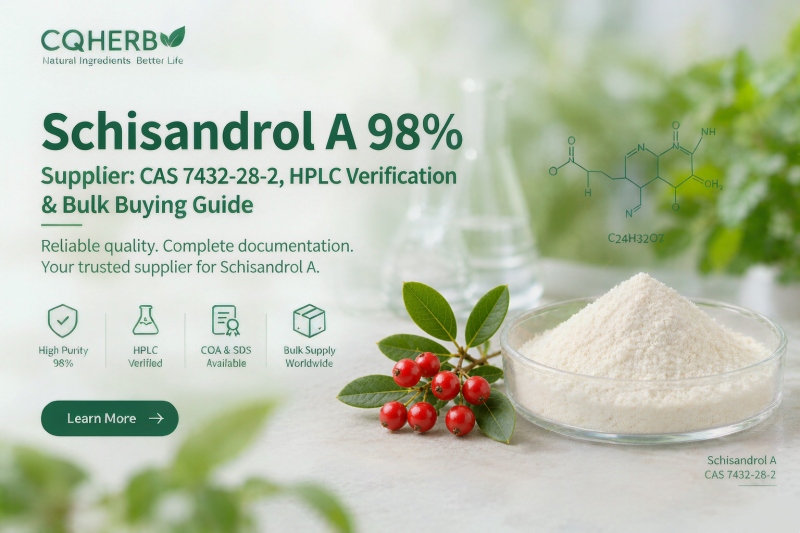
  • Schisandrol A 98% Supplier: CAS 7432-28-2, HPLC Verification & Bulk Buying Guide
    Schisandrol A 98% Supplier: CAS 7432-28-2, HPLC Verification & Bulk Buying Guide
    Nov 10, 2026
    Schisandrol A 98% Supplier: CAS 7432-28-2, HPLC Verification & Bulk Buying Guide Quick Answer Schisandrol A (also known as Schisandrin or Schizandrin, CAS 7432-28-2) is the principal dibenzocyclooctadiene lignan of Schisandra chinensis fruit. When sourcing Schisandrol A 98%, the single most important verification point is whether the supplier's HPLC method actually separates Schisandrol A from its closely related isomers (Schisandrol B, Schisandrin B and C, gomisin-type lignans) — a generic purity number alone cannot tell you this. Request the batch chromatogram, confirm the main peak identity, and check storage and packaging details before scaling to commercial quantities. Key Takeaways · Schisandrol A = Schisandrin (Schizandrin): one compound, several names — confirm which one your specification means before comparing quotations. · Schisandra lignans form a family of structurally similar isomers; HPLC methods must resolve them, and "98%" without a chromatogram proves nothing. · ≥98% HPLC is the common high-purity grade for ingredient development and research use. · The compound is sensitive to light and moisture over time; cool, dry, light-protected storage protects batch consistency. · For US-bound supply, confirm the intended use and regulatory pathway with your own regulatory team — documentation requirements depend on the application. 1. Chemical Identity and Specifications Item Specification Product Name Schisandrol A (Schisandrin; Schizandrin) CAS Number 7432-28-2 Molecular Formula C₂₄H₃₂O₇ Molecular Weight 448.51 g/mol Compound Class Dibenzocyclooctadiene lignan Botanical Source Fruit of Schisandra chinensis (Chinese magnolia vine) Appearance White to off-white crystalline powder Purity ≥98% (HPLC) Solubility Soluble in methanol, ethanol, DMSO; low solubility in water Documentation COA, HPLC, MS/NMR, SDS, TDS per batch Naming note: suppliers and literature use Schisandrol A, Schisandrin and Schizandrin interchangeably for CAS 7432-28-2. Some catalogs list "Schisandrol B" as a separate compound (a different, more saturated lignan). Because the names look similar, always match quotations by CAS number, not by name alone. 2. Schisandrol A 98% vs. Standardized Schisandra Extract Parameter Schisandrol A 98% (purified) Schisandra extract (standardized) Composition Single lignan compound Complex extract with multiple Schisandra lignans Purity basis ≥98% Schisandrol A by HPLC Total lignans or Schisandrol A content standardized Typical use Ingredient development, analytical reference, research Formulations where a defined extract is acceptable Analytical identity Single dominant peak with resolved isomer region Multi-peak lignan fingerprint Price logic Purity- and process-driven Raw-material- and ratio-driven Both product types are legitimate — the procurement risk is buying one while believing you ordered the other. Put the CAS number and the purity basis in your specification sheet before requesting quotations. 3. HPLC Verification: The Isomer Question This is where Schisandrol A sourcing differs from most botanical single compounds. Schisandra chinensis contains a family of closely related dibenzocyclooctadiene lignans — Schisandrol A, Schisandrol B, Schisandrin B, Schisandrin C, gomisin A, gomisin N and others — several of which elute close together on typical reversed-phase methods. When auditing a Schisandrol A 98% batch file: 1. Ask for the full chromatogram, not the purity figure. Check that the isomer region is resolved and that minor lignan peaks are reported. 1. Confirm main-peak identity. MS or NMR data should support that the dominant peak is Schisandrol A (CAS 7432-28-2), not a co-eluting isomer such as Schisandrol B. 1. Method transparency. Column type, mobile phase, wavelength and integration parameters should be stated, so your own lab can reproduce the result. 1. Impurity and residue data. Residual solvents and heavy metals should match the requirements applicable to your market and intended use. 1. Batch traceability. The COA batch number must match the drum labels of the shipment you receive. A practical sequence used by many procurement teams: order a 20 g sample with full documentation, run independent HPLC (ideally with an isomer-resolution check) at a third-party laboratory, then scale. CQ HERB supports this sample-first model with batch-specific documentation. 4. Stability, Packaging and Storage · Light and moisture: lignans gradually degrade under light exposure and humid conditions; containers should be sealed and light-protected. · Storage: cool and dry, protected from light; follow the SDS/TDS for the specific grade. Research-grade solutions in DMSO are typically stored frozen in aliquots. · Shelf life: typically 24 months under recommended conditions; check the retest date on the COA. · Formulation note: low water solubility — ethanol, glycol or DMSO-based premixes are common in development work. Confirm compatibility with your system early. · Shipping: standard sealed export packaging; for humid climates, confirm desiccant and moisture-barrier arrangements with your supplier. 5. Intended Applications and Regulatory Context Schisandrol A 98% is supplied for: · Ingredient development and research — as a reference compound and botanical-derived active for phytochemistry, analytical method development and natural-product research. · Formulation development — as a raw material for product development teams working with Schisandra-derived ingredients. Regulatory note: Schisandra chinensis extracts are familiar to North American and European buyers, but permitted use, labeling and claim language differ by market and application. Confirm the intended use and applicable framework with your regulatory team. CQ HERB supplies the ingredient with technical documentation — it is not a finished product and carries no product claims. 6. Supplier Evaluation Checklist · Full HPLC chromatogram with resolved isomer region · Main-peak identity confirmed by MS or NMR · Quotation matched by CAS number, not by product name · Heavy metals and residual solvents reported · Botanical source and extraction process described transparently · COA / SDS / TDS internally consistent · Sample available for third-party verification · Moisture-barrier packaging and light-protected storage confirmed · Multi-batch supply stability and lead-time transparency Nanjing Spring & Autumn Biological Engineering Co., Ltd. (CQ HERB) supplies Schisandrol A 98% with batch-based documentation including COA, HPLC analytical data, MS/NMR, SDS and TDS, and supports sample evaluation before bulk orders. Our quality management system is certified to ISO 9001. 7. Bulk Ordering Practicalities · Sample stage: 20 g with full documentation for independent verification. · Development quantities: 100 g–1 kg for pilot work. · Commercial quantities: multi-kg volumes scheduled against forecast; quoted on request. · Packaging: double PE bags in fiber drums; foil pouches for small batches; moisture-barrier protection for humid destinations. · Lead time: confirm current stock and production schedule at quotation. FAQ Q: What is the CAS number of Schisandrol A? A: CAS 7432-28-2. Schisandrol A is also known as Schisandrin or Schizandrin; molecular formula C₂₄H₃₂O₇, MW 448.51 g/mol. Q: Are Schisandrol A and Schisandrol B the same compound? A: No. They are distinct lignans found in the same plant. Match your specification by CAS number and confirm the HPLC method resolves the isomers. Q: What purity grade should I buy? A: ≥98% HPLC is the common high-purity grade for ingredient development and research use; standardized Schisandra extracts are a separate product category. Q: Why is the chromatogram more important than the purity number? A: Because Schisandra lignans are structurally similar, a method that does not resolve the isomer region can overstate the purity of a specific compound. The chromatogram shows what the number hides. Q: How should Schisandrol A be stored? A: Cool, dry, light-protected, in tightly sealed containers. Refer to the SDS/TDS for batch-specific guidance. Q: Can I get a sample before a bulk order? A: Yes. CQ HERB provides sample quantities with batch-specific documentation so buyers can complete independent verification first. Conclusion Schisandrol A sourcing rewards suppliers who can prove isomer-level analytical control. Match quotations by CAS number, audit the full chromatogram rather than a single purity figure, plan for low water solubility and light-protected storage, and validate the regulatory pathway for your market. A supplier with transparent batch documentation and sample-first evaluation removes most of the risk before the first drum ships. Related reading: Schisandra chinensis Extracts — Product Category · Natural Active Compounds · Ruscogenin 98% Supplier: CAS 472-11-7 Sourcing Guide Contact CQ HERB for Schisandrol A 98% specifications, samples, and bulk supply inquiries — Ives Shen, International Sales Dept. · sale05@cqherb.com · www.cqherb.com
    Read More
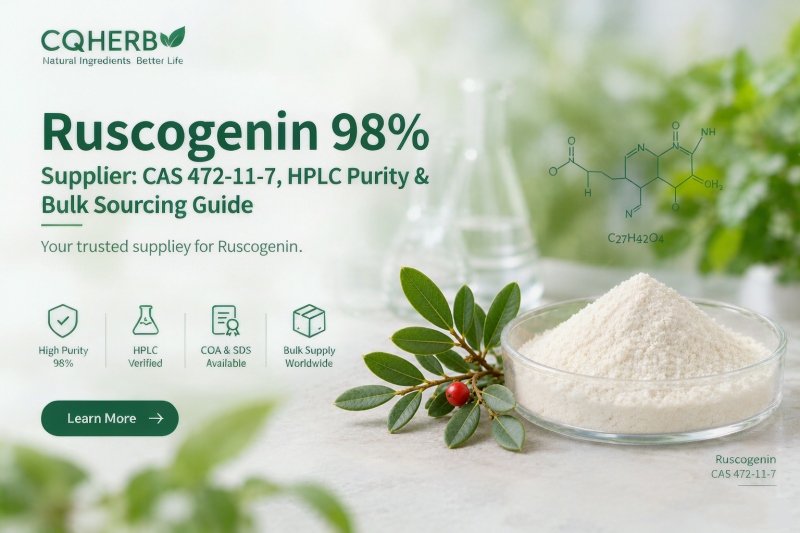
  • Ruscogenin 98% Supplier: CAS 472-11-7, HPLC Purity & Bulk Sourcing Guide
    Ruscogenin 98% Supplier: CAS 472-11-7, HPLC Purity & Bulk Sourcing Guide
    Nov 05, 2026
    Ruscogenin 98% Supplier: CAS 472-11-7, HPLC Purity & Bulk Sourcing Guide Quick Answer Ruscogenin (CAS 472-11-7) is a steroidal sapogenin obtained primarily from Ruscus aculeatus (butcher's broom) root. When sourcing Ruscogenin 98%, verify four things before ordering: a batch-specific HPLC chromatogram, the botanical source statement, identity confirmation data (MS/NMR or IR), and storage-relevant documentation. Because the material is a purified single compound with a defined melting range, identity and purity can be checked analytically — which is why buyers should insist on real batch data rather than a template COA. Key Takeaways · Ruscogenin is a steroidal sapogenin (C₂₇H₄₂O₄, MW 430.63), not a standardized plant extract — the two are different products with different price logic. · ≥98% HPLC is the common high-purity specification used in ingredient development and research applications. · Request batch COA + actual HPLC chromatogram + MS/NMR data; confirm the batch number on the documents matches your shipment. · Storage at 2–8 °C, light-protected, matters: ruscogenin is sensitive to prolonged air and light exposure. · Solubility in water is low; formulations typically rely on ethanol- or glycol-based systems — confirm the grade and presentation with your supplier early. · Documentation expectations differ by market; for US-bound cosmetic or research supply, confirm the intended use with your regulatory team. 1. Chemical Identity and Specifications Item Specification Product Name Ruscogenin (Ruscogenine) CAS Number 472-11-7 Molecular Formula C₂₇H₄₂O₄ Molecular Weight 430.63 g/mol Botanical Source Ruscus aculeatus L. root (butcher's broom) Appearance White to off-white crystalline powder Purity ≥98% (HPLC) Melting Point 182–186 °C Solubility Soluble in DMSO, ethanol; low solubility in water Storage 2–8 °C, protected from light and moisture Documentation COA, HPLC, MS/NMR, SDS, TDS per batch Ruscogenin belongs to the spirostane-type steroidal sapogenins. Its defined melting range and single-compound nature make it practical to verify identity by melting point determination, IR, or MS, in addition to HPLC purity — a useful cross-check when evaluating a new supplier. 2. Ruscogenin 98% vs. Standardized Butcher's Broom Extract Buyers frequently compare quotations for products that are not equivalent: Parameter Ruscogenin 98% (purified) Butcher's broom extract (standardized) Composition Single steroidal sapogenin Complex extract containing ruscogenin plus other saponins Purity basis ≥98% Ruscogenin by HPLC Ruscogenin content standardized to a stated level Typical use Ingredient development, analytical reference, research Formulations where a defined extract is acceptable Price logic Purity- and process-driven Raw-material- and ratio-driven Analytical identity Sharp single HPLC peak Multi-peak botanical fingerprint If your specification calls for "98% ruscogenin", a 10%–30% standardized extract will not satisfy it, regardless of the price difference. Confirm the analytical basis in writing before comparing costs. 3. HPLC and COA Verification: What to Check A credible Ruscogenin 98% batch file should include: 1. Batch-specific HPLC chromatogram — with column type, mobile phase, detection wavelength, and integration parameters, not just a percentage. 1. Identity confirmation — MS and/or NMR data supporting the spirostane structure; melting point within 182–186 °C is a quick secondary check. 1. Impurity profile — related sapogenins and process-related impurities, reported or stated as within specification. 1. Residual solvents and heavy metals — results should match the requirement set applicable to your market and intended use. 1. SDS and TDS — consistent with the COA and current for the grade supplied. 1. Batch traceability — the batch number on the COA must match the labels on the drums you receive. A practical procurement sequence: request a 20 g sample with the full documentation package, run independent HPLC verification at a third-party laboratory, then scale to commercial quantities. CQ HERB supports this sample-first evaluation model with batch-specific documentation. 4. Solubility, Formulation Handling and Stability Ruscogenin is poorly water-soluble, which shapes how formulators work with it: · Solvent systems: ethanol, glycol, or DMSO-based premixes are common in development work; confirm compatibility with your final system early. · Thermal exposure: keep processing temperatures well below the melting range and avoid prolonged heat during incorporation. · Light and air: the material should be handled in closed containers, protected from light; long exposure to air reduces content over time. · Storage: 2–8 °C, dry, light-protected. Shelf life is typically stated as 36 months under recommended conditions; check the retest date on the COA. · Shipping: for warm-climate destinations, confirm insulated packaging and transit documentation with your supplier — heat exposure during transit is a common, avoidable quality issue. 5. Intended Applications and Regulatory Context Ruscogenin 98% is supplied for: · Cosmetic raw-material development — used by formulators as a botanical-derived active ingredient in skin and body care development; finished-product claims are the responsibility of the brand and must comply with the applicable cosmetic regulation in the destination market. · Research and analytical applications — as a reference compound for phytochemical, chromatographic, and natural-product research. Regulatory note: permitted use, labeling, and claim language for ruscogenin-containing products differ by market. US-bound supply may fall under cosmetic ingredient or research-material frameworks depending on intended use and how the material is presented; buyers should confirm the applicable pathway with their regulatory team. CQ HERB supplies the ingredient with technical documentation — it is not a finished product and carries no product claims. 6. Supplier Evaluation Checklist · Batch-specific HPLC chromatogram provided · MS/NMR or IR identity data available · Melting range stated and consistent with specification · Heavy metals and residual solvents reported · Botanical source and extraction process described transparently · COA / SDS / TDS internally consistent · Sample available for third-party verification · Cold-chain or insulated shipping arranged for warm destinations · Multi-batch supply stability and lead-time transparency Nanjing Spring & Autumn Biological Engineering Co., Ltd. (CQ HERB) supplies Ruscogenin 98% with batch-based documentation including COA, HPLC analytical data, MS/NMR, SDS and TDS, and supports sample evaluation before bulk orders. Our quality management system is certified to ISO 9001. 7. Bulk Ordering Practicalities · Sample stage: 5 g with full documentation, suitable for independent verification. · Development quantities: 25 g–100 g for pilot formulation work. · Commercial quantities: 500 g–1 kg and above, scheduled against forecast; larger volumes quoted on request. · Packaging: sealed, moisture-barrier inner packaging in outer drums; cold-chain or insulated options for warm-climate destinations. · Lead time: confirm current stock and production schedule at quotation. FAQ Q: What is the CAS number of Ruscogenin? A: CAS 472-11-7; molecular formula C₂₇H₄₂O₄; molecular weight 430.63 g/mol. Q: Is Ruscogenin the same as butcher's broom extract? A: No. Ruscogenin is a single purified steroidal sapogenin; butcher's broom extract is a complex botanical preparation that may be standardized to a stated ruscogenin content. Q: What purity should I specify? A: ≥98% HPLC is the common high-purity grade for ingredient development and research use. Standardized extracts are a separate product category. Q: How should Ruscogenin 98% be stored? A: 2–8 °C, dry, protected from light, in tightly closed containers. Refer to the SDS/TDS for the specific grade. Q: Can I receive a sample before a bulk order? A: Yes. CQ HERB provides 20 g samples with batch-specific documentation so buyers can complete independent verification first. Q: Does Ruscogenin dissolve in water? A: Solubility in water is low. Ethanol, glycol, or DMSO-based systems are typically used in development work; discuss your formulation format with the supplier. Conclusion Sourcing Ruscogenin 98% comes down to verification discipline: confirm you are comparing a purified compound against a standardized extract, audit the batch-specific HPLC and identity data, plan for low water solubility and cool, light-protected storage, and validate the regulatory pathway for your market and intended use. A supplier that provides real batch documentation and sample-first evaluation removes most of the risk from the purchase. Related reading: Ruscogenin (CAS 472-11-7): A High-Purity Steroidal Sapogenin for Advanced Research · Natural Active Compounds · Cosmetic Active Ingredients Contact CQ HERB for Ruscogenin 98% specifications, samples, and bulk supply inquiries — Ives Shen, International Sales Dept. · sale05@cqherb.com · www.cqherb.com
    Read More
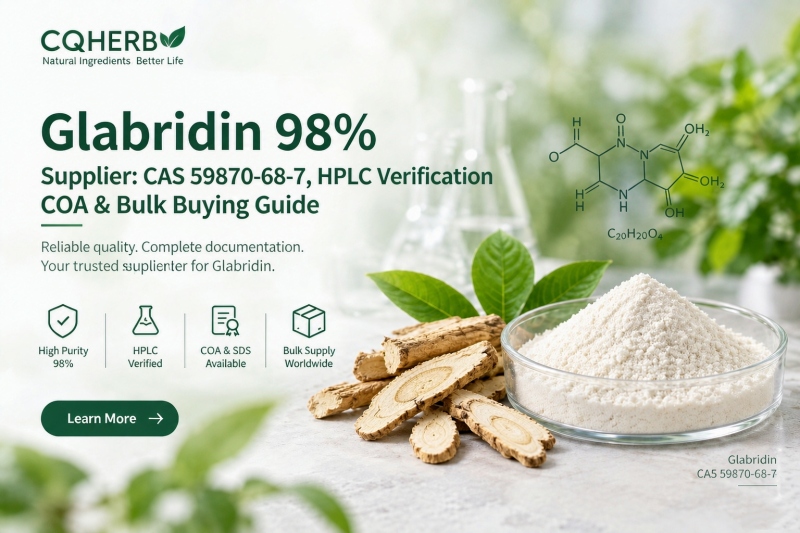
  • Glabridin 98% Supplier: CAS 59870-68-7, HPLC Verification & Bulk Buying Guide
    Glabridin 98% Supplier: CAS 59870-68-7, HPLC Verification & Bulk Buying Guide
    Oct 30, 2026
    Glabridin (CAS 59870-68-7) is a prenylated isoflavan purified from the root of Glycyrrhiza glabra (licorice). When sourcing Glabridin 98%, buyers should verify three things before placing an order: batch-specific HPLC chromatograms (not just a COA summary), botanical origin and extraction process documentation, and heavy-metal and residual-solvent data consistent with the destination market's cosmetic or research-use regulations. Reputable suppliers provide 20 g-scale samples with complete documentation before commercial quantities. Key Takeaways · Glabridin is the key purified isoflavan in licorice root; commercial grades range from standardized licorice extracts (10%–40%) to high-purity ≥98% HPLC material. · "98% Glabridin" and "licorice extract standardized to 40% glabridin" are different products with different price structures — confirm which one you are comparing. · Always request: batch COA, HPLC chromatogram, SDS, heavy metals, residual solvents, and botanical source statement. · Glabridin is light- and oxidation-sensitive; packaging and storage conditions directly affect batch-to-batch consistency. · Regulatory status differs by market and application — confirm the intended use (cosmetic ingredient, research compound) with your regulatory team before purchase. 1. Chemical Identity and Specifications Item Specification Product Name Glabridin CAS Number 59870-68-7 Molecular Formula C₂₀H₂₀O₄ Molecular Weight 324.37 g/mol Botanical Source Root of Glycyrrhiza glabra L. Appearance White to off-white crystalline powder Purity ≥98% (HPLC) Solubility Soluble in ethanol, DMSO; poorly soluble in water Documentation COA, HPLC, SDS, TDS available per batch Because Glabridin is a single purified compound rather than a standardized extract, buyers can verify identity and purity analytically with standard laboratory methods, which is one reason it is widely used in cosmetic raw-material and natural-product research programs. 2. Glabridin 98% vs. Standardized Licorice Extract: Know What You Are Comparing A frequent source of confusion in licorice-derived quotations is the difference between purified Glabridin and standardized licorice extract: Parameter Glabridin 98% (purified compound) Licorice extract (standardized, e.g. 40% Glabridin) Composition Single isoflavan compound Complex extract with multiple licorice constituents Purity basis ≥98% Glabridin by HPLC Glabridin content standardized, balance is other extractives Typical use Cosmetic actives, analytical reference, research Finished-product formulations, cost-driven applications Price basis Per-kilogram, purity-driven Lower unit cost, higher inclusion rates Analytical identity Sharp single HPLC peak Multiple-peak fingerprint Before comparing quotations, confirm the basis: "98% Glabridin" and "40% Glabridin licorice extract" are not interchangeable, and neither price nor formulation math can be compared directly. 3. HPLC Verification: What a Valid COA Should Contain When auditing a supplier's Certificate of Analysis for Glabridin 98%, check for the following: 1. Batch-specific data. The COA must reference the exact batch number you will receive. Template COAs without batch numbers are a warning sign. 2. HPLC method and chromatogram. Ask for the actual chromatogram, not only the purity figure. The report should state the column type, detection wavelength, and integration method. 3. Identity confirmation. For high-value shipments, IR or MS confirmation of structure adds assurance that the compound is Glabridin rather than a co-eluting peak. 4. Impurity profile. Residual licorice congeners (e.g., glabrene, liquiritigenin) and process-related impurities should be reported or stated as within specification. 5. Heavy metals and residual solvents. Results should align with the requirements of your destination market — for example, the technical documentation expectations for cosmetic raw materials in the EU or North America. 6. SDS and TDS. Safety data and technical data sheets should be current and consistent with the COA. A practical approach used by many procurement teams: request a 20 g sample with full documentation, run independent HPLC verification at a third-party laboratory, then move to commercial quantities. CQ HERB supports sample evaluation with batch-specific documentation for this purpose. 4. Stability, Packaging and Storage Glabridin is sensitive to light and oxidation. In practice, this affects bulk handling: · Packaging: double-layer PE bags inside fiber drums for 1–25 kg quantities; sealed foil bags for smaller development batches. · Storage: cool, dry, light-protected conditions; keep containers tightly closed. · Shelf life: typically 24 months when stored as recommended; retest dates should appear on the COA. · Formulation note: because solubility in water is low, formulators commonly work with ethanol-based or solubilized systems; discuss the intended formulation format with your supplier so the recommended grade and particle presentation match. 5. Intended Applications and Regulatory Context Glabridin 98% is supplied for: · Cosmetic raw-material development — as a botanical-derived active ingredient used by formulators in skin-care product development, where the finished product's claims must comply with local cosmetic regulations. · Research applications — as a reference compound and research material in phytochemistry and natural-product studies. Regulatory note: the permitted use, labeling, and claim language for Glabridin-containing products differ by market (cosmetic ingredient frameworks, ingredient nomenclature such as INCI, and local advertising rules). Buyers should confirm the intended use and destination-market requirements with their own regulatory team. CQ HERB supplies the ingredient together with technical documentation; the ingredient itself is not a finished product and carries no product claims. 6. Supplier Evaluation Checklist Use this checklist when comparing Glabridin suppliers: · Batch-specific HPLC chromatogram provided (not just a purity number) · Botanical origin and extraction process described transparently · Heavy metals and residual solvents reported · SDS, TDS, and COA consistent with each other · Sample policy: small-quantity samples available for third-party verification · Traceable production information and stable multi-batch supply · Export documentation experience for your destination market · Responsive technical support (not only sales support) Nanjing Spring & Autumn Biological Engineering Co., Ltd. (CQ HERB) supplies Glabridin 98% with batch-based quality documentation including COA, HPLC analytical data, SDS and TDS, and supports sample evaluation before bulk orders. Our quality management system is certified to ISO 9001. 7. Bulk Ordering Practicalities · Sample stage: 20 g with full documentation for independent verification. · Development batches: 1–5 kg, typically ex-stock or short lead time. · Commercial quantities: 25 kg fiber drums; larger volumes scheduled against forecast. · Shipping: export-standard packaging; documentation set provided per shipment. · Lead time: confirm current stock and production schedule when requesting quotation. FAQ Q: What CAS number is Glabridin? A: Glabridin is CAS 59870-68-7, molecular formula C₂₀H₂₀O₄, molecular weight 324.37 g/mol. Q: Is Glabridin the same as licorice extract? A: No. Glabridin is a single purified compound isolated from licorice root. Licorice extract is a complex botanical preparation that may be standardized to a defined Glabridin content. Q: What purity grade should I buy? A: ≥98% HPLC is the common specification for cosmetic raw-material development and research use. Standardized licorice extracts (lower Glabridin content) are a separate product category with a different cost structure. Q: Which documents should a Glabridin supplier provide? A: At minimum: batch COA, HPLC chromatogram, SDS, TDS, botanical source statement, and heavy-metal/residual-solvent data as applicable to your market. Q: Can I get a sample before bulk purchase? A: Yes. CQ HERB provides sample quantities with batch-specific documentation so buyers can complete independent verification before commercial orders. Q: How should Glabridin be stored? A: In cool, dry, light-protected conditions in tightly closed containers. Refer to the SDS and TDS for batch-specific guidance.
    Read More
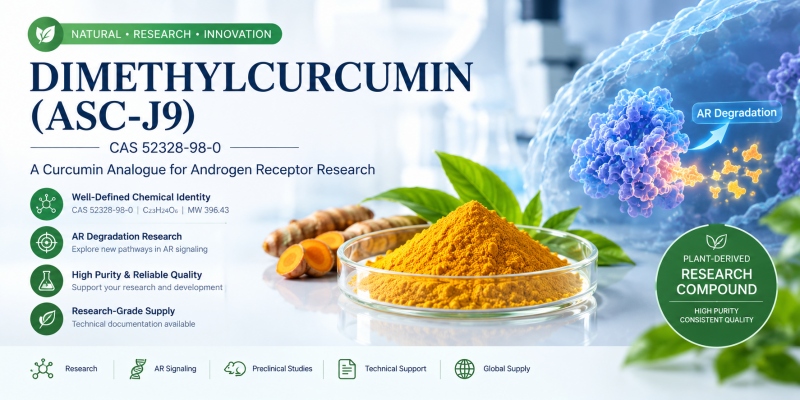
  • Dimethylcurcumin (ASC-J9) CAS 52328-98-0: Chemical Properties, Androgen Receptor Research, Applications & Buying Guide
    Dimethylcurcumin (ASC-J9) CAS 52328-98-0: Chemical Properties, Androgen Receptor Research, Applications & Buying Guide
    Sep 24, 2026
    Dimethylcurcumin (ASC-J9) CAS 52328-98-0: Chemical Properties, Androgen Receptor Research, Applications & Buying Guide A Research-Oriented Guide to a Curcumin Analogue and Androgen Receptor Degradation Enhancer CAS No. 52328-98-0 | Molecular Formula C23H24O6 | Molecular Weight 396.43 g/mol     Quick Answer Dimethylcurcumin, commonly known as ASC-J9 or GO-Y025, is a synthetic curcumin analogue that has been extensively investigated in laboratory and preclinical research related to androgen receptor (AR) signaling. Its chemical identity is associated with CAS No. 52328-98-0, molecular formula C23H24O6, and molecular weight 396.43 g/mol. Unlike conventional androgen receptor antagonists that primarily interfere with androgen binding or receptor signaling, ASC-J9 has been investigated as an androgen receptor degradation enhancer. Research has examined its ability to promote degradation of androgen receptor proteins and thereby alter AR-dependent signaling in experimental models. Published studies have investigated ASC-J9 in a range of experimental systems, including prostate cancer models, androgen receptor-associated disorders, bladder cancer models, and spinal and bulbar muscular atrophy research. These studies include in vitro cellular experiments and in vivo animal models; such findings should not be interpreted as evidence of established clinical efficacy in humans. For researchers and organizations sourcing Dimethylcurcumin, important purchasing considerations include chemical identity, purity, analytical characterization, batch consistency, storage conditions, and supporting technical documentation.     Key Takeaways · Dimethylcurcumin is also known as ASC-J9 and GO-Y025. · CAS Number: 52328-98-0. · Molecular Formula: C23H24O6. · Molecular Weight: 396.43 g/mol. · It is a synthetic curcumin analogue, rather than native curcumin itself. · ASC-J9 has been investigated as an androgen receptor degradation enhancer. · Published research has examined its effects on AR protein degradation and AR-related signaling. · Research has included prostate cancer, bladder cancer, spinal and bulbar muscular atrophy, and other AR-associated experimental models. · Research-grade ASC-J9 is commonly supplied as a solid/powder and may require low-temperature storage depending on the supplier's specification. · Analytical verification is important when purchasing high-purity Dimethylcurcumin for research. · ASC-J9 should be presented on a research-oriented website as a research compound, not as an approved therapeutic product.     1. What Is Dimethylcurcumin (ASC-J9)? Dimethylcurcumin is a synthetic compound structurally related to curcumin and is widely known in the scientific literature as ASC-J9. The compound is identified chemically as: (1E,4Z,6E)-1,7-bis(3,4-dimethoxyphenyl)-5-hydroxyhepta-1,4,6-trien-3-one Public chemical databases list Dimethylcurcumin, ASC-J9, and GO-Y025 among its synonyms. PubChem identifies CAS No. 52328-98-0 and molecular formula C23H24O6, with a molecular weight of approximately 396.4 g/mol. Commercial research suppliers also identify ASC-J9 using the same CAS number and molecular formula and commonly describe high-purity material as a research-grade powder. Although its name contains "curcumin," Dimethylcurcumin should not be treated as simply another commercial grade of curcumin. It is a distinct synthetic curcumin analogue with its own molecular structure and research profile. This distinction is particularly important for purchasing, analytical testing, literature searches, and regulatory documentation.     2. Dimethylcurcumin vs. Curcumin The relationship between Dimethylcurcumin and curcumin is an important point for researchers. Curcumin is a naturally occurring diarylheptanoid associated with Curcuma longa. Dimethylcurcumin, by contrast, is a chemically modified analogue that contains methoxy-substituted aromatic groups and has a different molecular formula and molecular weight. Property Dimethylcurcumin / ASC-J9 Curcumin Common Name Dimethylcurcumin Curcumin CAS 52328-98-0 458-37-7 Formula C23H24O6 C21H20O6 Molecular Weight 396.43 g/mol 368.38 g/mol Relationship Synthetic curcumin analogue Naturally occurring curcuminoid Research Focus AR degradation and AR-related signaling Broad pharmacological and biochemical research Research Status Experimental/research compound Widely studied natural compound The two compounds therefore should not be substituted for one another simply because they belong to the broader curcumin-analogue research area.     3. Chemical Identification of ASC-J9 Accurate chemical identification is particularly important for research compounds because different suppliers may use overlapping synonyms. Core Chemical Information Property Information Product Name Dimethylcurcumin Common Research Name ASC-J9 Alternative Name GO-Y025 CAS Number 52328-98-0 Molecular Formula C23H24O6 Molecular Weight 396.43 g/mol Chemical Class Curcumin analogue IUPAC Name (1E,4Z,6E)-1,7-bis(3,4-dimethoxyphenyl)-5-hydroxyhepta-1,4,6-trien-3-one Physical Form Solid / powder Research Target Androgen receptor-related research The identity and molecular information above are supported by PubChem and commercial analytical product records.     4. Why Is ASC-J9 Important in Research? The scientific interest surrounding ASC-J9 largely comes from its unusual relationship with the androgen receptor. The androgen receptor (AR) is a nuclear receptor that regulates gene transcription in response to androgen hormones. AR signaling has important physiological roles and has also been extensively investigated in diseases and biological conditions in which androgen signaling is altered. ASC-J9 attracted research attention because studies indicated that it could promote AR protein degradation, rather than simply competing with androgens for receptor binding. This creates an important conceptual distinction: ASC-J9 research focuses on changing the abundance and activity of AR protein, while conventional antiandrogen research often focuses on blocking receptor activation. Early research demonstrated that ASC-J9 could disrupt interactions between AR and selected coregulators and increase AR degradation in experimental systems. Subsequent studies expanded this research into additional AR-associated models.     5. How Does ASC-J9 Work in Experimental Research? AR Degradation as a Research Mechanism One of the defining characteristics of ASC-J9 is its reported ability to enhance degradation of androgen receptor protein. Research has suggested that ASC-J9 can interfere with interactions between AR and selected coregulators, leading to increased AR degradation. Experimental work has also linked ASC-J9-mediated AR degradation to proteasome-dependent processes. This mechanism is different from simply reducing androgen production. The conceptual pathway can be simplified as: ASC-J9 ↓ Alteration of AR–coregulator interactions ↓ Enhanced AR degradation ↓ Reduced AR protein abundance ↓ Changes in AR-dependent transcription ↓ Changes in downstream cellular responses This model has been investigated primarily through laboratory and animal studies.     6. What Does the Scientific Literature Show? Research on ASC-J9 spans more than a decade. An early study published in Nature Medicine investigated ASC-J9 in a model of spinal and bulbar muscular atrophy. The study reported that ASC-J9 disrupted interactions between androgen receptor and coregulators and increased degradation of the mutant androgen receptor in experimental systems. The researchers also investigated the compound in transgenic mice. Later research examined ASC-J9 in prostate cancer models. Studies reported degradation of both full-length AR and an AR splice variant in experimental prostate cancer cell models, accompanied by reduced AR transcriptional activity and cell growth. Additional preclinical studies investigated ASC-J9 in combination with other experimental approaches, including radiation and chemotherapy models. For example, research published in Cancer Letters examined the combination of ASC-J9 with docetaxel in castration-resistant prostate cancer models. A review published in 2021 summarized research involving ASC-J9 across multiple AR-associated disease models, including prostate cancer, benign prostatic hyperplasia, bladder cancer, liver disease, spinal and bulbar muscular atrophy, ovarian cancer, and melanoma. Important Scientific Qualification These publications demonstrate research interest and preclinical findings, not established clinical efficacy. Therefore, CQHERB's website should describe ASC-J9 in terms such as: · Research compound · Research chemical · Curcumin analogue · AR degradation research · Experimental compound · Preclinical research and should avoid presenting ASC-J9 as an approved medicine or making direct therapeutic claims.     7. Research Applications of Dimethylcurcumin ASC-J9 has been investigated in several research areas. 7.1 Androgen Receptor Research This is the most characteristic research application. Researchers use ASC-J9 to investigate: · AR protein degradation · AR signaling · AR transcriptional activity · AR–coregulator interactions · AR-dependent cellular pathways     7.2 Prostate Cancer Research ASC-J9 has been investigated in multiple prostate cancer cell and animal models, including models of castration-resistant prostate cancer. Studies have examined whether AR degradation can alter tumor-cell proliferation and AR-dependent signaling. These findings remain within the context of experimental research and should not be presented as evidence that ASC-J9 is an approved cancer treatment.     7.3 Spinal and Bulbar Muscular Atrophy Research ASC-J9 has also been studied in models of spinal and bulbar muscular atrophy, a condition associated with mutant androgen receptor aggregation. The original study reported that ASC-J9 reduced mutant AR aggregation and improved disease-related phenotypes in experimental mice.     7.4 Bladder Cancer Research Research has also investigated ASC-J9 in bladder cancer models, particularly in relation to AR and NF-κB signaling and chemotherapy response.     8. Analytical Considerations for ASC-J9 For research-grade Dimethylcurcumin, chemical identity and purity should be verified through appropriate analytical methods. Commonly relevant analytical techniques include: HPLC HPLC can be used to evaluate chromatographic purity and batch consistency. LC-MS / MS Mass spectrometry can support molecular identity confirmation and quantitative analysis. A published analytical method specifically developed LC-MS/MS determination of ASC-J9 in mouse serum and tissues. NMR NMR can provide structural characterization and is particularly useful when confirming the identity of research compounds. COA A Certificate of Analysis should identify the product, batch, assay/purity, analytical method, and relevant quality parameters. For high-value research compounds, buyers should ideally review analytical documentation before placing larger orders.     CQHERB Technical Insight For Dimethylcurcumin and other research-oriented botanical or bioactive compounds, identity and analytical traceability should be considered alongside purity. A reliable research-material supplier should be able to clearly distinguish: Product identity → analytical method → purity → batch information → storage → documentation This is especially important for ASC-J9 because the compound is known under several names, including Dimethylcurcumin, ASC-J9 and GO-Y025. Using the CAS number 52328-98-0 together with the molecular formula and analytical documentation can help minimize purchasing and identification errors.     9. Storage and Handling Publicly available research-product specifications commonly recommend storing ASC-J9 at low temperature, with −20°C being specified by several commercial research suppliers. For commercial research material, customers should follow the supplier-specific COA, SDS and storage instructions rather than relying on a generic recommendation. Recommended purchasing documentation should include: · Product specification · COA · SDS/MSDS · Storage conditions · Batch number · Retest or expiry information where applicable · Analytical data upon request     10. Who Uses Dimethylcurcumin? ASC-J9 is primarily relevant to organizations conducting laboratory and preclinical research. Potential users include: · University research laboratories · Pharmaceutical research organizations · Biotechnology companies · Molecular biology laboratories · Cancer biology research groups · Androgen receptor research laboratories · Drug discovery teams · Academic research institutions The appropriate use and regulatory status depend on the customer's jurisdiction, research protocol, and intended application.     11. Buyer Guide: How to Evaluate an ASC-J9 Supplier When sourcing Dimethylcurcumin, buyers should not evaluate suppliers based solely on the advertised purity number. A more complete evaluation should include: 1. Correct Chemical Identity Confirm: CAS 52328-98-0 and cross-check the molecular formula and analytical data. 2. Purity Method Ask whether the stated purity is determined by HPLC or another analytical method. 3. Batch Documentation Request a current COA corresponding to the actual batch. 4. Structural Confirmation For research-grade material, MS and/or NMR data can provide additional confidence in chemical identity. 5. Storage Confirm storage temperature and packaging conditions. 6. Supply Consistency For repeated research programs, batch-to-batch consistency can be more important than obtaining the lowest initial quotation.     12. Why Research Buyers Should Distinguish ASC-J9 From Curcumin One common purchasing error is assuming that Dimethylcurcumin can be substituted with curcumin simply because ASC-J9 is a curcumin analogue. This is incorrect. The two compounds have different molecular formulas, molecular weights, structures, and research profiles. Therefore, research protocols specifying: ASC-J9 / Dimethylcurcumin / CAS 52328-98-0 should not automatically be replaced with curcumin or another curcuminoid. For reproducible experimental research, the exact compound specified in the protocol should be sourced and analytically verified.     13. Frequently Asked Questions What is ASC-J9? ASC-J9 is a research name for Dimethylcurcumin, a synthetic curcumin analogue investigated particularly for its ability to enhance androgen receptor degradation. What is the CAS number of ASC-J9? The CAS number is 52328-98-0. What is the molecular formula of Dimethylcurcumin? The molecular formula is C23H24O6. What is the molecular weight of ASC-J9? The molecular weight is approximately 396.43 g/mol. Is ASC-J9 the same as curcumin? No. ASC-J9 is a distinct synthetic curcumin analogue with a different molecular structure and molecular formula. What is ASC-J9 mainly researched for? ASC-J9 has been extensively investigated in androgen receptor-related research, particularly research involving AR degradation and signaling. Is ASC-J9 a conventional androgen receptor antagonist? Its research mechanism is distinct from conventional AR antagonists. ASC-J9 has primarily been investigated as an AR degradation enhancer, affecting AR protein abundance rather than simply blocking androgen binding. What research models have been used? Published research includes cell-based studies and animal models involving prostate cancer, spinal and bulbar muscular atrophy, bladder cancer, and other AR-associated conditions. How should ASC-J9 be stored? Several commercial research specifications recommend storage at approximately −20°C, but buyers should follow the storage instructions supplied with the specific batch. What documents should I request when purchasing ASC-J9? At minimum, buyers should consider requesting a COA and SDS/MSDS. For research applications, HPLC, MS and/or NMR information may also be useful.     14. References & Further Reading For the published scientific basis of this guide, useful starting points include: 1. Yang Z, et al. ASC-J9 ameliorates spinal and bulbar muscular atrophy phenotype via degradation of androgen receptor. Nature Medicine. 2. Lai KP, et al. Research on ASC-J9 and androgen receptor degradation in prostate cancer models. 3. Cheng MA, et al. Androgen receptor degradation enhancer ASC-J9® in an FDA-approved formulated solution suppresses castration resistant prostate cancer cell growth. Cancer Letters. 4. Hu H, Zhou H, Xu D. A review of the effects and molecular mechanisms of dimethylcurcumin (ASC-J9) on androgen receptor-related diseases. Chemical Biology & Drug Design. 2021. 5. Research on LC-MS/MS determination and pharmacokinetic distribution of ASC-J9 in experimental animals. 6. Research investigating ASC-J9 in combination with chemotherapy in experimental prostate cancer models.     Looking for Dimethylcurcumin (ASC-J9) for Research? CQHERB provides botanical extracts and research-oriented bioactive compounds for international customers, with technical documentation available according to product and batch. For Dimethylcurcumin (ASC-J9), CAS 52328-98-0, customers can discuss requirements such as: · Required purity · Research quantity · COA · HPLC analytical data · MS/NMR documentation where available · SDS/MSDS · Packaging · Storage requirements · International shipment requirements For research and formulation development, please contact the CQHERB technical sales team with your required quantity and specification.
    Read More
  • Bakuchiol (CAS 10309-37-2): The Ultimate Guide to Benefits, Applications, Retinol Comparison & Buying Guide (2026)
    Bakuchiol (CAS 10309-37-2): The Ultimate Guide to Benefits, Applications, Retinol Comparison & Buying Guide (2026)
    Jun 30, 2026
    Bakuchiol (CAS 10309-37-2): The Ultimate Guide to Benefits, Applications, Retinol Comparison & Buying Guide (2026) Natural Retinol Alternative for Next-Generation Cosmetic Formulations Improve Skin Texture • Support Collagen Production • Gentle for Sensitive Skin • Ideal for Premium Skincare Products Quick Answer Bakuchiol (CAS 10309-37-2) is a naturally occurring meroterpene extracted primarily from the seeds and leaves of Psoralea corylifolia (commonly known as Babchi). Over the past decade, it has become one of the most sought-after botanical active ingredients in the global cosmetic industry due to its ability to deliver retinol-like anti-aging benefits with significantly improved skin tolerance. Scientific studies indicate that Bakuchiol can help reduce the appearance of fine lines and wrinkles, improve skin elasticity, enhance skin firmness, and support collagen synthesis. Unlike traditional retinoids, Bakuchiol is generally well tolerated by sensitive skin and is less likely to cause redness, peeling, or irritation, making it a preferred choice for modern skincare formulations. Today, Bakuchiol is widely incorporated into anti-aging serums, facial creams, eye treatments, facial oils, masks, and clean beauty products. As consumer demand continues to shift toward plant-derived and sustainable cosmetic ingredients, Bakuchiol has become one of the fastest-growing active ingredients in premium skincare worldwide. Key Takeaways Naturally derived cosmetic active ingredient from Psoralea corylifolia. CAS Number: 10309-37-2. Recognized globally as a leading natural alternative to retinol. Supports collagen production and improves visible signs of skin aging. Provides antioxidant and soothing benefits for sensitive skin. Compatible with modern cosmetic ingredients such as niacinamide, peptides, ceramides, and hyaluronic acid. Widely used in clean beauty, vegan, and premium skincare formulations. Increasingly adopted by international cosmetic brands seeking plant-based anti-aging solutions. Available in high-purity cosmetic-grade specifications for formulation development and commercial production. Who Should Read This Guide? Whether you are a cosmetic formulator, skincare brand owner, ingredient distributor, purchasing manager, or research professional, this guide provides comprehensive and practical information about Bakuchiol. In this guide, you will learn: What Bakuchiol is and why it has become a popular cosmetic ingredient. How Bakuchiol differs from retinol. The latest scientific understanding of its anti-aging properties. Common cosmetic applications and formulation considerations. How to evaluate product quality and choose a reliable supplier. Frequently asked questions from cosmetic manufacturers and international buyers. Our goal is to provide a practical resource that supports both technical understanding and purchasing decisions. Why Is Bakuchiol Receiving Global Attention? The global skincare market has undergone a significant transformation over the past decade. Consumers are no longer satisfied with products that simply promise visible results—they increasingly seek ingredients that combine proven efficacy, excellent skin compatibility, and naturally derived origins. Retinol has long been regarded as the gold standard for anti-aging skincare. However, many consumers experience undesirable side effects such as dryness, redness, peeling, and increased photosensitivity, particularly those with sensitive or compromised skin barriers. These limitations have encouraged cosmetic researchers and formulators to search for botanical alternatives capable of delivering comparable cosmetic benefits with improved tolerability. Bakuchiol has emerged as one of the most promising answers to this demand. Although its chemical structure differs completely from vitamin A derivatives, numerous scientific investigations have shown that Bakuchiol can influence several biological pathways associated with skin renewal, collagen metabolism, and wrinkle reduction. This unique combination of efficacy and skin friendliness has positioned Bakuchiol as a preferred ingredient for modern anti-aging formulations. At the same time, the rapid growth of clean beauty, vegan cosmetics, and naturally derived skincare products has further accelerated the commercial adoption of Bakuchiol across North America, Europe, Japan, South Korea, and other major cosmetic markets. What Is Bakuchiol? Bakuchiol is a naturally occurring meroterpene phenol isolated primarily from the seeds and leaves of Psoralea corylifolia, a medicinal plant traditionally used in Asian herbal medicine for centuries. While the plant has a long history in traditional healthcare, Bakuchiol itself has gained widespread recognition only in recent years as scientific research has revealed its remarkable cosmetic potential. Unlike retinol, which belongs to the vitamin A family, Bakuchiol possesses an entirely different molecular structure. Nevertheless, modern biological studies suggest that it can regulate the expression of several genes involved in skin repair, extracellular matrix remodeling, and collagen production. This explains why many formulators describe Bakuchiol as a "natural retinol alternative," even though it is not chemically related to retinoids. Its excellent compatibility with sensitive skin, combined with antioxidant activity and broad formulation flexibility, has made Bakuchiol one of the most valuable plant-derived active ingredients in premium cosmetic formulations. Today, Bakuchiol is commonly found in: Anti-aging facial serums Firming creams Eye creams Moisturizers Facial oils Overnight repair treatments Premium clean beauty products Sensitive skin formulations Its versatility allows formulators to create effective skincare products for consumers seeking visible anti-aging benefits while avoiding many of the limitations associated with traditional retinoids. Chemical Identification Property Information Product Name Bakuchiol CAS Number 10309-37-2 Molecular Formula C18H24O Molecular Weight 256.38 g/mol Appearance Pale yellow to amber viscous liquid Botanical Source Psoralea corylifolia Seeds Solubility Soluble in oils, ethanol, and many cosmetic solvents Recommended Storage Store in a cool, dry place away from direct sunlight Shelf Life Typically 24 months under recommended storage conditions About CQHERB Nanjing Spring & Autumn Biological Engineering Co., Ltd. (CQHERB) specializes in the research, production, and global supply of high-quality botanical extracts and cosmetic active ingredients. With extensive experience serving cosmetic manufacturers, ingredient distributors, and research institutions worldwide, we are committed to providing reliable raw materials supported by comprehensive technical documentation and consistent quality. Our Bakuchiol is manufactured under strict quality management procedures to ensure excellent batch-to-batch consistency for formulation development and commercial production. Supporting documentation—including the Certificate of Analysis (COA), Technical Data Sheet (TDS), and Safety Data Sheet (SDS/MSDS)—is available upon request. We also offer flexible packaging options and customized supply solutions to meet the needs of global customers. Table of Contents   Botanical Source of Bakuchiol Extraction and Manufacturing Process Physical and Chemical Properties Mechanism of Action Scientific Research and Clinical Studies Benefits of Bakuchiol for Skin Cosmetic Applications Bakuchiol vs. Retinol: What's the Difference? Formulation Guide Safety and Stability How to Choose a Reliable Bakuchiol Supplier Frequently Asked Questions References    
    Read More
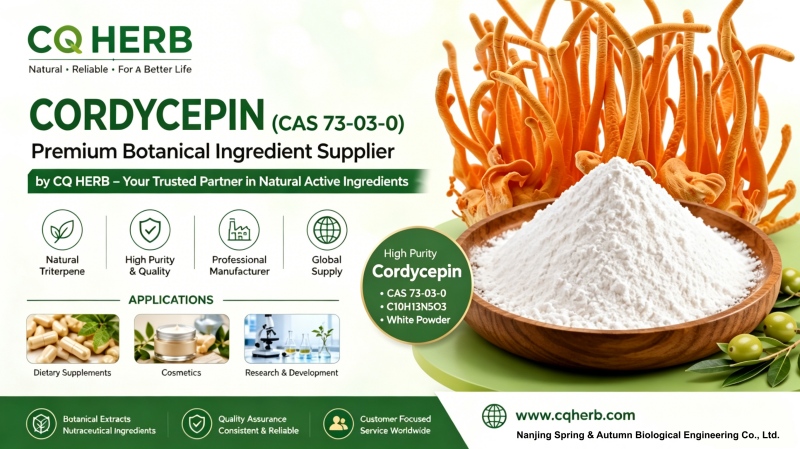
  • CQ HERB Cordycepin 98% Supplier & Manufacturer | Cordycepin CAS 73-03-0
    CQ HERB Cordycepin 98% Supplier & Manufacturer | Cordycepin CAS 73-03-0
    Jun 24, 2026
    CQ HERB Cordycepin 98% (CAS 73-03-0): High Purity Cordycepin Supplier & Manufacturer As interest in natural bioactive compounds continues to grow, Cordycepin (CAS 73-03-0) has become one of the most widely studied ingredients derived from Cordyceps militaris. CQ HERB is a professional supplier and manufacturer of high-purity Cordycepin, providing reliable ingredient solutions for nutraceutical, cosmetic, and scientific research applications worldwide. What Is Cordycepin? Cordycepin, also known as 3'-Deoxyadenosine, is a naturally occurring nucleoside compound primarily found in Cordyceps militaris, a medicinal mushroom that has been used and studied for centuries. Due to its unique chemical structure, Cordycepin has attracted increasing attention from researchers, product developers, and ingredient manufacturers. Product Information Item Specification Product Name Cordycepin CAS Number 73-03-0 Molecular Formula C10H13N5O3 Molecular Weight 251.24 Appearance White to Off-White Powder Purity 98% HPLC Source Cordyceps Militaris Brand CQ HERB About Cordyceps Militaris Cordyceps militaris is one of the most recognized medicinal fungi in the world and is considered an important natural source of Cordycepin. Compared with traditional fungal extracts, purified Cordycepin 98% offers greater consistency, standardized quality, and easier formulation for product developers. Today, Cordyceps militaris-derived ingredients are increasingly utilized in dietary supplements, nutraceutical products, and scientific research projects. Why Is Cordycepin Receiving Growing Attention? Researchers continue to investigate Cordycepin because of its unique chemical properties and natural origin. Current areas of scientific interest include: Natural nucleoside compounds Medicinal mushroom research Functional ingredient development Nutraceutical innovation Cosmetic ingredient exploration Biotechnology research As research progresses, Cordycepin remains one of the most important active compounds isolated from Cordyceps militaris. Applications of CQ HERB Cordycepin 98% Dietary Supplement Development Cordycepin is frequently evaluated as a high-value ingredient in dietary supplement formulations. Potential applications include: Capsules Tablets Powder blends Functional nutrition products Scientific Research High-purity Cordycepin is widely supplied for: Natural product research Mushroom-derived compound studies Analytical reference applications Biotechnology research projects Cosmetic Ingredient Development The cosmetic industry continues to explore naturally derived active ingredients. Cordycepin may be evaluated for use in: Premium skincare formulations Botanical cosmetic products Research-oriented cosmetic applications Why Choose CQ HERB Cordycepin? High Purity CQ HERB supplies Cordycepin 98% tested by HPLC to ensure product consistency and quality. Professional Manufacturing As a specialized botanical ingredient manufacturer, CQ HERB maintains strict production and quality control standards. Global Supply Capability We provide: COA Product Specifications Technical Documentation Batch Traceability Export Support Customer-Oriented Service CQ HERB works closely with customers worldwide to provide customized ingredient solutions and reliable supply support. Quality Standards at CQ HERB Quality is a core priority at CQ HERB. Our manufacturing and quality management process focuses on: Raw material verification Standardized production Analytical testing Batch consistency International documentation support These measures help ensure that customers receive dependable Cordycepin ingredients for their projects and formulations. How to Select a Reliable Cordycepin Supplier When sourcing Cordycepin bulk ingredients, buyers should evaluate suppliers based on: Product Quality HPLC purity verification Reliable specifications Stable supply capacity Manufacturing Experience Botanical extraction expertise Industry experience Quality management systems Technical Support COA availability Regulatory documents Responsive communication Choosing an experienced Cordycepin manufacturer can help streamline procurement and product development processes. Why Global Customers Choose CQ HERB CQ HERB specializes in botanical extracts, nutraceutical ingredients, and cosmetic raw materials. Our advantages include: Professional Cordycepin manufacturer International export experience Customized specifications Reliable quality control Dedicated customer support We are committed to helping customers develop innovative products based on high-quality natural ingredients. Frequently Asked Questions What is Cordycepin? Cordycepin is a naturally occurring nucleoside compound primarily derived from Cordyceps militaris. What is the CAS number of Cordycepin? The CAS number of Cordycepin is 73-03-0. What purity does CQ HERB offer? CQ HERB supplies high-purity Cordycepin 98% tested by HPLC. Is Cordycepin suitable for dietary supplement formulations? Cordycepin is commonly supplied as a raw material ingredient for nutraceutical and dietary supplement product development. Can CQ HERB provide technical documentation? Yes. We provide COA, specifications, and other technical documents upon request. Partner with CQ HERB If you are looking for a reliable Cordycepin supplier, Cordycepin manufacturer, or Cordyceps militaris extract specialist, CQ HERB is ready to support your sourcing and development needs. For quotations, specifications, and technical documentation, please contact CQ HERB through www.cqherb.com.
    Read More
  • CQ HERB Lupeol Supplier & Manufacturer | High Purity Lupeol CAS 545-47-1
    CQ HERB Lupeol Supplier & Manufacturer | High Purity Lupeol CAS 545-47-1
    Jun 12, 2026
    CQ HERB Lupeol (CAS 545-47-1): Trusted Botanical Ingredient Supplier for Global Industries As the global market for botanical active ingredients continues to expand, CQ HERB has become a trusted name in the supply of high-quality plant-derived compounds for nutraceutical, cosmetic, and research applications. One of our key products is Lupeol (CAS 545-47-1), a naturally occurring pentacyclic triterpene widely found in fruits, vegetables, and medicinal plants. With growing interest in natural-origin ingredients, Lupeol has gained attention from formulators and manufacturers worldwide. About CQ HERB CQ HERB is the international brand of Nanjing Spring & Autumn Biological Engineering Co., Ltd., a professional manufacturer and supplier of botanical extracts, nutraceutical ingredients, and cosmetic raw materials in China. Our website: www.cqherb.com CQ HERB focuses on: Botanical active ingredients Nutraceutical raw materials Cosmetic ingredients Plant extract manufacturing Custom ingredient solutions With years of export experience, CQ HERB serves customers in North America, Europe, Asia, and other international markets.   What Is Lupeol? Lupeol is a natural pentacyclic triterpene with the molecular formula C30H50O. It is commonly isolated from botanical sources such as mango peel, olive fruits, aloe species, cabbage, and other medicinal plants.   Basic Product Information Item Description Product Name Lupeol CAS Number 545-47-1 Molecular Formula C30H50O Molecular Weight 426.72 Appearance White to off-white powder Category Pentacyclic triterpene Applications Dietary supplements, cosmetics, research   CQ HERB Lupeol: Quality You Can Trust At CQ HERB, we provide high-purity Lupeol powder manufactured under strict quality control standards. Our Lupeol ingredient is suitable for use in dietary supplement development, cosmetic formulations, and scientific research applications. Why Choose CQ HERB as Your Lupeol Supplier? Professional Lupeol Manufacturer in China CQ HERB operates as a dedicated botanical extract factory with established production and quality management systems. Consistent Product Quality We provide: HPLC-tested Lupeol Certificate of Analysis (COA) Product specifications Batch traceability Microbiological and heavy metal testing Global Export Experience CQ HERB has extensive experience supplying botanical ingredients to international customers, supporting smooth communication, documentation, and logistics. Technical Support & Customization We support customers with: Technical documentation Customized purity specifications Application consultation Bulk supply solutions   Applications of CQ HERB Lupeol 1. Dietary Supplement Formulations Lupeol is increasingly explored as a plant-derived ingredient in nutraceutical and wellness formulations. It is commonly used in: Capsule products Tablet formulations Botanical blends Plant-based supplement systems CQ HERB supplies Lupeol as a raw material ingredient for product development and manufacturing use only. 2. Cosmetic & Personal Care Products The cosmetic industry continues to favor natural-origin active ingredients. CQ HERB Lupeol may be incorporated into: Skin care creams Facial serums Botanical cosmetic formulations Premium personal care products 3. Research & Development Lupeol is also supplied for laboratory and research purposes related to natural product chemistry and botanical ingredient studies.   CQ HERB Manufacturing Standards As a responsible botanical ingredient supplier, CQ HERB emphasizes: Raw material traceability Standardized extraction processes Analytical verification Stable supply capacity International documentation support Our goal is to provide reliable botanical ingredients that meet the expectations of global B2B customers.   Frequently Asked Questions Is CQ HERB a Lupeol manufacturer or trader? CQ HERB is a professional botanical extract manufacturer and supplier with production capabilities and international export experience.   What purity of Lupeol does CQ HERB supply? We can provide different purity specifications according to customer requirements. Please contact us for the latest specifications and quotations.   Can CQ HERB provide technical documents? Yes. We provide COA, specifications, analytical reports, and other technical documents for qualified customers.   What industries use Lupeol? Lupeol is mainly used in dietary supplements, cosmetics, nutraceuticals, and research applications.   Partner with CQ HERB If you are looking for a reliable Lupeol supplier, Lupeol manufacturer, or botanical ingredient factory in China, CQ HERB is ready to support your business with consistent quality and professional service. Contact CQ HERB Website: www.cqherb.com Company: Nanjing Spring & Autumn Biological Engineering Co., Ltd. Product: Lupeol (CAS 545-47-1) For quotations, specifications, and bulk supply inquiries, please contact our sales team through our website.
    Read More
  • Why Global Buyers Choose CQ Herb as Their Trusted Natural Compound Supplier
    Why Global Buyers Choose CQ Herb as Their Trusted Natural Compound Supplier
    Jun 03, 2026
    Why Global Buyers Choose CQ Herb as Their Trusted Natural Compound Supplier In today's rapidly evolving pharmaceutical, nutraceutical, cosmetic, and biotechnology industries, sourcing high-quality natural compounds has become more important than ever. Buyers are no longer looking for suppliers who simply provide products—they seek reliable partners capable of delivering consistent quality, technical expertise, and long-term support. This is where CQ Herb stands out. As a professional manufacturer and supplier of natural compounds, botanical extracts, and phytochemical ingredients, CQ Herb has become a trusted partner for customers worldwide. Who Is CQ Herb? CQ Herb is the international brand of Nanjing Spring & Autumn Biological Engineering Co., Ltd., a company dedicated to the research, development, production, and global distribution of high-value natural active ingredients. Our product portfolio includes: Natural compounds Herbal extracts Cosmetic active ingredients Pharmaceutical raw materials Functional food ingredients Customized plant-derived compounds Over the years, we have supplied customers across North America, Europe, Asia, and other international markets, supporting research institutions, ingredient distributors, pharmaceutical companies, and cosmetic manufacturers. Commitment to Quality Quality is the foundation of every successful partnership. At CQ Herb, we implement strict quality control procedures throughout the manufacturing process. Our quality management system includes: Raw material verification Production process monitoring HPLC analysis Purity testing Batch consistency evaluation Final product inspection For many products, we can provide: Certificate of Analysis (COA) HPLC Chromatograms Product Specifications MSDS Technical Data Sheets Our goal is to ensure that every batch delivered meets customer expectations and application requirements. Extensive Natural Compound Portfolio One of the key reasons global buyers choose CQ Herb is our extensive range of natural ingredients. Our product categories include: Flavonoids Examples include: Licochalcone A Glabridin Liquiritigenin Isoliquiritigenin Naringenin Saponins Examples include: Ginsenoside Rg1 Ginsenoside Rg3 Asiaticoside Cycloastragenol Derivatives Terpenoids Examples include: Oridonin Celastrol Arglabin Costunolide Specialized Botanical Actives Examples include: Geniposide Genipin Cordycepin Nobiletin Schisandrol A Our continuously expanding catalog allows customers to source multiple ingredients from a single reliable supplier. Supporting Cosmetic Innovation The cosmetic industry increasingly demands scientifically supported natural ingredients. CQ Herb supplies a variety of cosmetic-active compounds used in formulations targeting: Anti-aging Skin soothing Brightening Antioxidant protection Skin barrier support Ingredients such as Licochalcone A, Glabridin, and Bakuchiol have gained significant attention among cosmetic developers seeking naturally derived alternatives. Serving Pharmaceutical and Research Markets Many of our customers operate in pharmaceutical research, biotechnology, and academic laboratories. We understand the importance of: High purity Consistent specifications Reliable documentation Technical communication Timely delivery Our team works closely with customers to help identify suitable products and specifications for their development projects. Customized Solutions for Global Buyers Every project is different. To meet diverse market requirements, CQ Herb offers flexible solutions including: Customized purity levels Small-scale research quantities Bulk commercial quantities Product specification adjustments Technical documentation support Whether customers require grams for laboratory research or kilograms for industrial production, we strive to provide efficient and professional service. Global Service and Professional Communication Successful international business depends on clear communication and responsive support. CQ Herb is committed to: Fast inquiry responses Transparent quotations Technical assistance Export documentation support Long-term customer relationships We believe that trust is built through consistency, professionalism, and continuous improvement. Looking Toward the Future As demand for natural ingredients continues to grow worldwide, CQ Herb remains focused on expanding its product portfolio, strengthening quality systems, and supporting innovation across multiple industries. Our mission is simple: To provide high-quality natural compounds and dependable service to customers around the world. Partner with CQ Herb Whether you are searching for cosmetic active ingredients, pharmaceutical raw materials, botanical extracts, or specialized natural compounds, CQ Herb is ready to support your sourcing needs. Contact our team today to learn more about our products, technical capabilities, and customized solutions.
    Read More
  • Unlocking the Power of Tetrandrine (CAS: 518-34-3): Benefits, Sources & Premium Supply from CQ Herb
    Unlocking the Power of Tetrandrine (CAS: 518-34-3): Benefits, Sources & Premium Supply from CQ Herb
    May 09, 2026
    Introduction In the evolving landscape of botanical research and specialty nutraceuticals, plant-derived alkaloids are gaining unprecedented attention for their targeted biological activity. Among them, Tetrandrine stands out as a highly researched bisbenzylisoquinoline alkaloid with potent anti-inflammatory, immunomodulatory, and calcium-channel modulating properties. At Nanjing Spring & Autumn Biological Engineering Co., Ltd. (CQ Herb), we specialize in the precision extraction and supply of high-purity plant alkaloids. Whether you are developing pharmaceutical intermediates, advanced research reagents, or specialized functional formulations, understanding the science, sourcing, and supply chain of Tetrandrine is essential for product success. This guide explores its profile, applications, and why CQ Herb is your trusted global partner. What is Tetrandrine? Tetrandrine (CAS: 518-34-3, Molecular Formula: C₃₈H₄₂N₂O₆) is a naturally occurring bisbenzylisoquinoline alkaloid primarily isolated from the dried roots of Stephania tetrandra (Han Fang Ji). Recognized for its complex pharmacological profile, it interacts with multiple cellular pathways, including calcium channel modulation, NF-κB signaling inhibition, and autophagy regulation. CQ Herb supplies Tetrandrine in multiple specifications tailored to your R&D or production needs, with 98%+ HPLC purity as our standard for pharmaceutical and laboratory use. Lower potency extracts (e.g., 50%-80%) are also available for early-stage formulation screening. Premium Natural Source & Advanced Extraction Consistency begins at the source. Our Tetrandrine is sustainably harvested from certified Stephania tetrandra rootstocks cultivated in controlled agricultural zones. The extraction process leverages: Green Solvent Recovery Systems to minimize environmental impact Preparative HPLC & Crystallization for ultra-high purity Strict Residual Solvent Testing (ICH Q3C compliant) Batch-to-Batch Standardization via fingerprint chromatography This ensures every shipment meets pharmacopeial standards for heavy metals, pesticides, microbiological limits, and alkaloid consistency. Key Applications & Research-Backed Benefits Tetrandrine’s multi-target activity makes it highly valuable across several B2B sectors: 🔬 Pharmaceutical & Drug Development Widely utilized as a reference compound or active intermediate in research targeting fibrosis, autoimmune modulation, and oncology pathways. Its calcium antagonistic properties also support cardiovascular and metabolic research. 🧪 Nutraceutical & Functional Health Formulations Incorporated into joint health, inflammatory response, and cellular wellness formulations. Often paired with synergistic botanicals for targeted metabolic or immune-support products (subject to regional regulatory compliance). 🧴 Dermatological & Cosmetic Research Studied for its potential to modulate skin inflammation, support barrier integrity, and protect against oxidative stress in advanced topical serums and clinical-grade skincare. 📊 Laboratory & QC Standards High-purity isolates (≥98% HPLC) serve as certified reference materials for pharmacopeias, academic labs, and quality control testing in herbal and pharmaceutical manufacturing. Why Global Buyers Trust CQ Herb for Tetrandrine Supply Sourcing a consistent, compliant alkaloid requires more than just a catalog listing. Here’s why international clients choose CQ Herb: ✅ Direct Manufacturer Pricing: Zero intermediaries. Competitive MOQs with transparent cost structures.✅ Pharma-Grade Quality Control: Every batch tested for Heavy Metals, Pesticides, Residual Solvents, Microbial Limits, and HPLC Purity. ISO 9001 & GMP-aligned facilities.✅ Custom Specification Support: Adjust purity, particle size, salt forms, or packaging (foil bags, drums, vacuum-sealed) to match your formulation or stability requirements.✅ Global Logistics & Compliance: Proven export experience to North America, Europe, Southeast Asia, and the Middle East. Shipping via DHL, FedEx, Air Freight, or Sea Cargo with proper SDS classification.✅ Complete Documentation Package: COA, HPLC Chromatograms, MSDS, Method of Analysis, Stability Reports, and regulatory support (REACH, DMF coordination available upon request). Frequently Asked Questions (FAQ) Q: What is the standard lead time for Tetrandrine orders?A: Sample orders (10g–100g) ship within 3–5 business days after payment confirmation. Bulk production (1kg+) typically requires 7–12 working days, depending on specification and current inventory. Q: Do you offer free samples for testing?A: Yes. We provide complimentary samples (10g–20g) for R&D evaluation. Customers only cover courier shipping fees. Q: What are your payment terms?A: For samples and small orders: PayPal, Western Union, or T/T. For bulk shipments: 30% deposit via T/T, with 70% balance before dispatch. Secure payment gateways available for eligible regions. Q: Can you provide regulatory or pharmacopeial documentation?A: Absolutely. We supply full COAs, HPLC/GC-MS reports, residual solvent data, and can assist with REACH, DMF, or regional registration dossiers upon NDA signing. Q: How should Tetrandrine powder be stored?A: Store in a cool, dry, light-protected environment at 2–8°C in airtight packaging. Under proper conditions, shelf life is typically 24 months from manufacture date. Ready to Source Premium Tetrandrine for Your Project? Partner with CQ Herb for consistent, compliant, and cost-effective botanical alkaloid supply. Whether you need a 10g research sample or a multi-kilogram production batch, our technical team is ready to support your formulation goals. 📧 Email: sale05@cqherb.com🌐 Website: www.cqherb.com🏭 Company: Nanjing Spring & Autumn Biological Engineering Co., Ltd. (CQ Herb) 📥 Request a free sample, COA, or bulk quotation today. Reply within 24 hours with technical datasheets and pricing.
    Read More

leave a message

leave a message
If you are interested in our products and want to know more details,please leave a message here,we will reply you as soon as we can.
submit

home

products

WhatsApp

contact