Cyclopamine (CAS 4449-51-8): Research Guide, Chemical Information, Botanical Source and Hedgehog Pathway Background
Aug 11, 2026
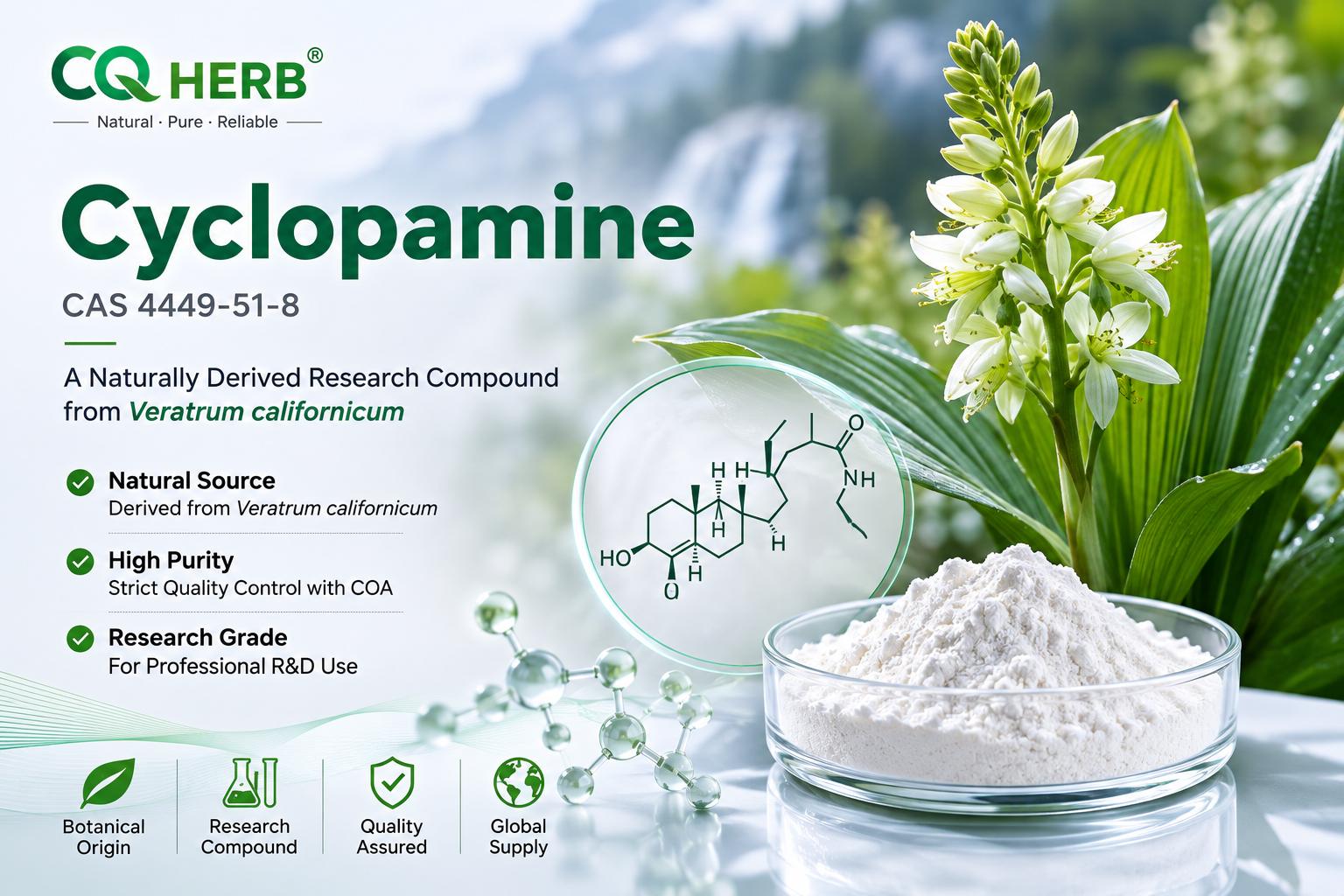
Cyclopamine is a naturally occurring steroidal alkaloid associated with the plant *Veratrum californicum*, commonly known as corn lily or California false hellebore. It has attracted considerable attention in biochemical and cell-signaling research because of its interaction with the Hedgehog (Hh) signaling pathway.
For researchers and technical buyers, cyclopamine is primarily relevant as a research compound and molecular tool for investigating Hedgehog signaling, Smoothened (SMO), and related cellular processes.
This guide provides an overview of cyclopamine's chemical identity, botanical origin, research background, mechanism of action in the Hedgehog pathway, analytical considerations, and procurement considerations for laboratory research.
Research-use notice: Cyclopamine is discussed here as a research compound. The information on this page is provided for scientific and educational purposes and is not intended to describe cyclopamine as a pharmaceutical product or to recommend its use for the diagnosis, prevention, or treatment of any disease.
Quick Answer
Cyclopamine is a naturally occurring steroidal alkaloid associated with *Veratrum californicum*. Its CAS number is **4449-51-8**, and its molecular formula is **C27H41NO2**, with a molecular weight of approximately 411.6 g/mol.
In biochemical research, cyclopamine is best known as a small-molecule modulator of the **Hedgehog signaling pathway**, particularly through interaction with **Smoothened (SMO)**.
Because of its historical botanical origin and well-established role in Hedgehog pathway research, cyclopamine is frequently used as a reference compound in studies involving cellular signaling, developmental biology, molecular pharmacology, and compound screening.
Cyclopamine Chemical Information
The basic chemical information for cyclopamine is summarized below.
| Property | Information |
| ------------------------------------ | --------------------------------------------------- |
| Product Name | Cyclopamine |
| CAS Number | 4449-51-8 |
| Alternative Name | 11-Deoxojervine |
| Molecular Formula | C27H41NO2 |
| Molecular Weight | 411.6 g/mol |
| Chemical Class | Steroidal alkaloid |
| Natural Source | *Veratrum* species |
| Commonly Associated Botanical Source | *Veratrum californicum* |
| Research Area | Hedgehog signaling and related biochemical research |
| Typical Research Form | Solid / powder reference material |
According to PubChem, cyclopamine is also known by the synonym 11-deoxojervine and is classified as a steroidal alkaloid. PubChem records cyclopamine in several *Veratrum* species, including *Veratrum californicum*.
For procurement and analytical documentation, the CAS number **4449-51-8** is particularly important because it helps distinguish cyclopamine from other structurally related *Veratrum* alkaloids.
What Is the Botanical Source of Cyclopamine?
Cyclopamine is closely associated with *Veratrum californicum*, a plant commonly referred to as corn lily or California false hellebore.
*Veratrum californicum* is native to mountainous regions of western North America. The plant contains a group of structurally related steroidal alkaloids, including cyclopamine and other *Veratrum* alkaloids.
Research on *Veratrum californicum* has shown that the alkaloid composition can vary according to plant part, collection location, and growth stage. Modern analytical studies have identified cyclopamine together with other steroidal alkaloids in the plant.
This botanical variability is important when discussing plant extracts versus isolated compounds.
A **cyclopamine reference compound is not equivalent to a whole *Veratrum* extract**.
A botanical extract may contain multiple alkaloids and other plant constituents, while purified cyclopamine represents a defined chemical component. Research comparing *Veratrum californicum* extracts with individual alkaloids has demonstrated that different alkaloid combinations can produce different experimental effects in Hedgehog pathway assays.
Cyclopamine and the Hedgehog Signaling Pathway
One of the most important reasons cyclopamine is studied is its relationship with the Hedgehog signaling pathway.
The Hedgehog pathway is a conserved cellular signaling system involved in developmental and differentiation processes. In mammals, the pathway involves several key components, including:
* Hedgehog ligands
* Patched (PTCH) receptors
* Smoothened (SMO)
* Suppressor of Fused (SUFU)
* GLI transcription factors
When Hedgehog signaling is activated, changes in SMO activity influence downstream signaling events involving GLI transcription factors.
Cyclopamine became an important molecular research tool because it can interfere with Hedgehog pathway signaling at the level of Smoothened. Scientific literature describes cyclopamine as an antagonist of SMO and an inhibitor of Hedgehog pathway signaling.
This makes cyclopamine useful for laboratory studies designed to investigate the biological consequences of modulating Hedgehog signaling.
How Does Cyclopamine Interact With Smoothened?
Smoothened, commonly abbreviated as **SMO**, is a seven-transmembrane protein that plays a central role in Hedgehog signal transduction.
In simplified terms, Hedgehog signaling can be viewed as a regulatory sequence:
**Hedgehog ligand → PTCH → SMO → GLI → downstream gene expression**
Cyclopamine acts at the SMO stage of this signaling system.
Experimental studies have provided evidence that cyclopamine interacts with Smoothened and interferes with its signaling activity. This observation was important in establishing the relationship between cyclopamine and the Hedgehog pathway.
Because of this mechanism, cyclopamine is commonly included in experimental systems investigating:
* Hedgehog pathway activation
* Smoothened signaling
* GLI-dependent transcription
* Cellular differentiation
* Developmental signaling
* Small-molecule pathway modulation
* Mechanistic studies of Hedgehog-related biology
Importantly, these research applications should not be interpreted as an indication that cyclopamine is an approved therapeutic product.
Why Is Cyclopamine Important in Research?
Cyclopamine has a distinctive place in the history of Hedgehog signaling research.
Its botanical history preceded the discovery of its molecular mechanism. Research into abnormal developmental outcomes associated with ingestion of *Veratrum californicum* eventually led to the identification of cyclopamine as an active steroidal alkaloid. Decades later, studies established its connection with Hedgehog signaling.
This historical sequence made cyclopamine an important example of how a naturally occurring plant compound can contribute to the discovery and characterization of a cellular signaling pathway.
Today, cyclopamine continues to appear in scientific literature as a reference compound for studies involving Hedgehog pathway modulation.
A recent review of *Veratrum californicum* alkaloids also describes cyclopamine as the best-studied alkaloid from the plant in the context of Hedgehog signaling research.
Cyclopamine vs. *Veratrum californicum* Extract
One of the most common points of confusion is the difference between cyclopamine and *Veratrum californicum* extract.
| Feature | Cyclopamine | *Veratrum californicum* Extract |
| ------------------ | ----------------------------------------------- | ------------------------------------------------------- |
| Material Type | Defined chemical compound | Botanical extract |
| Composition | Primarily cyclopamine as the specified compound | Multiple naturally occurring constituents |
| CAS | 4449-51-8 | Depends on extract specification |
| Chemical Identity | Defined | Complex mixture |
| Research Use | Molecular and biochemical research | Botanical and phytochemical research |
| Analytical Control | Can be specified by chemical purity | Requires extract-specific marker or fingerprint testing |
| Interchangeable? | No | No |
A whole-plant extract should therefore not be represented simply as “cyclopamine.”
The distinction is especially important for technical documentation, specifications, COAs, customs documents, and research applications.
Cyclopamine and Related *Veratrum* Alkaloids
*Veratrum* plants contain a range of steroidal alkaloids. Cyclopamine is only one member of this chemically diverse group.
Other compounds reported in *Veratrum californicum* research include:
* Veratramine
* Muldamine
* Isorubijervine
* Jervine
* Other structurally related steroidal alkaloids
Modern analytical studies have demonstrated substantial variation in alkaloid composition depending on plant material and extraction conditions.
For researchers working with purified cyclopamine, this distinction is useful because biological results obtained from a complex botanical extract cannot automatically be attributed to cyclopamine alone.
## Analytical Identification of Cyclopamine
For research-grade cyclopamine, analytical characterization is an important part of quality control.
Common analytical approaches may include:
HPLC
High-performance liquid chromatography can be used to evaluate chromatographic purity and to monitor the presence of related components.
For a commercial research material, the analytical specification should clearly identify:
* Target compound
* CAS number
* Purity method
* Analytical result
* Batch number
* Test date
* Reference standard or analytical method where applicable
LC-MS
Liquid chromatography coupled with mass spectrometry can provide additional confirmation of molecular identity and help distinguish cyclopamine from structurally related *Veratrum* alkaloids.
Structural Information
PubChem lists cyclopamine under CAS 4449-51-8, molecular formula C27H41NO2, and molecular weight 411.6 g/mol.
For B2B research-material procurement, identity information should be consistent across the product specification, COA, SDS, label, and shipping documentation.
Factors to Consider When Purchasing Cyclopamine for Research
Researchers and purchasing teams should evaluate more than the stated purity percentage when sourcing cyclopamine.
1. Confirm the Chemical Identity
The CAS number should be clearly stated as:
**Cyclopamine — CAS 4449-51-8**
Alternative names such as 11-deoxojervine may also appear in scientific databases and literature.
2. Review the Analytical Specification
The supplier should be able to provide appropriate analytical documentation, such as:
* COA
* HPLC chromatogram where available
* Product specification
* SDS
* Batch information
* Appearance
* Purity result
3. Distinguish Purified Cyclopamine From Botanical Extract
If the project requires a defined compound, a whole *Veratrum* extract should not automatically be considered an equivalent material.
4. Consider Packaging
Cyclopamine should be handled and packaged according to the supplier's applicable chemical handling and storage specifications.
For international shipments, packaging should also be compatible with the requirements of the selected courier and destination country.
5. Check Documentation Before Shipment
International research-material shipments may require additional documentation depending on the destination, transport method, and local requirements.
Potential documentation can include:
* Commercial invoice
* Packing list
* SDS
* COA
* Product specification
* Customs information
* Transport-related documents where applicable
Buyers should confirm local import requirements before placing an international order.
Cyclopamine Storage and Handling
Cyclopamine is a research chemical and should be handled by appropriately trained personnel according to the supplier's SDS and laboratory procedures.
Storage conditions should follow the manufacturer's product specification and SDS rather than relying on generic recommendations.
For long-term storage, laboratories should also consider:
* Temperature control
* Moisture exposure
* Light exposure
* Container integrity
* Repeated opening and closing
* Batch traceability
The appropriate storage conditions may depend on the specific product specification, formulation, packaging configuration, and intended research workflow.
Is Cyclopamine a Pharmaceutical Product?
Cyclopamine should not be presented as an approved pharmaceutical product on a commercial research-material website.
Its importance in the scientific literature is primarily related to its role as a research compound and Hedgehog pathway modulator.
Although scientific studies have investigated cyclopamine and related compounds in various biological models, research findings should not be converted into claims that a commercial cyclopamine product can diagnose, prevent, or treat a disease.
This distinction is particularly important for international websites and digital advertising.
Google Ads' current Healthcare and Medicines policy restricts promotion of certain unapproved substances and prohibits marketing that implies an unapproved product is safe or effective for preventing, curing, or treating a disease.
Research Areas Associated With Cyclopamine
Because of its interaction with Smoothened and Hedgehog signaling, cyclopamine appears in research involving several scientific fields.
Cell Signaling Research
Cyclopamine can be used as a chemical tool for investigating changes associated with Hedgehog pathway modulation.
Developmental Biology
The Hedgehog pathway has important roles in developmental biology, making cyclopamine relevant to experimental studies of pathway function.
Molecular Pharmacology
Cyclopamine has historically been used to investigate Smoothened and the molecular pharmacology of Hedgehog signaling.
Drug Discovery Research
Cyclopamine has also served as a reference structure in research exploring small-molecule Hedgehog pathway modulators and related chemical scaffolds.
These descriptions refer to research contexts and should not be interpreted as commercial therapeutic claims.
Cyclopamine and Modern Hedgehog Pathway Research
Cyclopamine was one of the earliest small molecules identified as capable of interfering with Hedgehog signaling.
Subsequent research led to the development and investigation of additional Smoothened-targeting compounds and other Hedgehog pathway modulators.
Scientific reviews describe cyclopamine as an important historical tool for understanding SMO and Hedgehog signaling, while also noting limitations that affected its development as a therapeutic candidate.
For current laboratory research, cyclopamine therefore has particular value as a **mechanistic research compound**, rather than as a commercial therapeutic ingredient.
Why Researchers Specify CAS 4449-51-8
CAS numbers are particularly useful when ordering specialized research compounds.
The name “cyclopamine” may appear together with alternative names such as:
* Cyclopamine
* 11-Deoxojervine
* 11-Deoxyjervine
Using the CAS number **4449-51-8** alongside the product name can reduce ambiguity during:
* Supplier communication
* Purchase orders
* COA review
* SDS preparation
* Customs documentation
* Laboratory inventory management
* Analytical database searches
PubChem currently identifies 4449-51-8 as the CAS number for cyclopamine and lists 11-deoxojervine among its synonyms.
CQ HERB Cyclopamine Research Material
CQ HERB provides botanical-derived research compounds and plant extract materials for B2B customers, with technical documentation available according to the specific product specification.
For cyclopamine-related inquiries, customers can discuss:
* Required purity
* Research quantity
* Packaging
* COA requirements
* SDS requirements
* Analytical documentation
* Shipping destination
* Documentation required for international shipment
For technical purchasing, we recommend confirming the exact specification before placing an order, particularly when the project requires a defined purity level or analytical method.
Frequently Asked Questions
What is cyclopamine?
Cyclopamine is a naturally occurring steroidal alkaloid associated with *Veratrum californicum*. It is widely discussed in scientific literature because of its interaction with the Hedgehog signaling pathway.
What is the CAS number of cyclopamine?
The CAS number of cyclopamine is **4449-51-8**.
What is the molecular formula of cyclopamine?
The molecular formula is **C27H41NO2**, and PubChem lists a molecular weight of approximately **411.6 g/mol**.
What plant does cyclopamine come from?
Cyclopamine is particularly associated with *Veratrum californicum*, commonly known as corn lily or California false hellebore. It has also been reported in other *Veratrum* species.
Is cyclopamine the same as *Veratrum californicum* extract?
No. Cyclopamine is a defined chemical compound, whereas *Veratrum californicum* extract is a complex botanical mixture that may contain multiple steroidal alkaloids.
What is cyclopamine used for in research?
Cyclopamine is primarily used as a research compound for studying Hedgehog signaling, Smoothened, and related cellular and molecular processes.
Is cyclopamine an approved medicine?
Cyclopamine should not be represented on a commercial research-material website as an approved pharmaceutical product. Its primary relevance in this context is as a research compound.
Can cyclopamine be used in human or animal applications?
Any use involving humans or animals should be evaluated under the applicable institutional, regulatory, ethical, and safety requirements. This product page is intended for research and informational purposes and does not provide clinical or veterinary use recommendations.
How should cyclopamine be stored?
Storage should follow the specific supplier's SDS and product specification. Laboratories should maintain appropriate control of temperature, moisture, light exposure, and container integrity.
Key Takeaways
* Cyclopamine is a naturally occurring steroidal alkaloid.
* Its CAS number is **4449-51-8**.
* Its molecular formula is **C27H41NO2**.
* It is closely associated with *Veratrum californicum*.
* Cyclopamine is widely recognized in scientific literature as a Hedgehog pathway research compound.
* Its best-characterized molecular research target is Smoothened (SMO).
* Purified cyclopamine should not be confused with whole-plant *Veratrum* extracts.
* Research findings should not be presented as evidence of clinical efficacy or as a therapeutic recommendation.
* Buyers should confirm identity, purity, analytical documentation, SDS, packaging, and shipping requirements before procurement.
References
1. PubChem. Cyclopamine, CID 442972. National Center for Biotechnology Information.
2. Pharmacology of *Veratrum californicum* Alkaloids as Hedgehog Pathway Antagonists.
3. Cyclopamine Bioactivity by Extraction Method from *Veratrum californicum*.
4. Hedgehog pathway as a drug target: Smoothened inhibitors in development.
5. Native *V. californicum* Alkaloid Combinations Induce Differential Inhibition of Sonic Hedgehog Signaling.
6. I only have eye for ewe: the discovery of cyclopamine and development of Hedgehog pathway-targeting drugs.
Disclaimer
The information provided in this article is intended for scientific, educational, and research-reference purposes only. Cyclopamine is presented as a research compound and chemical reference material. Nothing on this page should be interpreted as medical advice, a therapeutic recommendation, or a claim that cyclopamine can diagnose, prevent, or treat any disease.
Users and purchasers are responsible for ensuring that their intended use, handling, storage, importation, and application of cyclopamine comply with applicable laws, regulations, institutional requirements, and safety procedures.
Read More
 English






 IPv6 network supported