English



What Are You Looking For?

Cycloastragenol is a high-value botanical compound of interest to natural product researchers, ingredient developers, and specialty raw material buyers. When sourcing Cycloastragenol 98%, buyers need to look beyond the purity figure on a product listing. Chemical identity, assay methodology, batch documentation, supply consistency, and supplier communication all matter when qualifying a material for further evaluation.
This guide explains how to evaluate Cycloastragenol 98%, what to review in a Certificate of Analysis (COA), how to prepare a bulk sourcing inquiry, and which questions to ask before placing an order.
To evaluate a Cycloastragenol 98% supplier, confirm the intended chemical identity and CAS number, request the current product specification and batch-specific COA, review the analytical method used to determine purity, and confirm the available quantity, packaging, storage recommendations, lead time, and shipping terms.
A listing that states “98% purity” is only a starting point. Buyers should understand how the assay result was obtained and whether the documentation corresponds to the exact material being offered.
For bulk purchasing, request written confirmation of the grade, minimum order quantity, available stock, sample options, and documentation before making a purchasing decision.
Confirm chemical identity: Match the product name, CAS number, molecular formula, and specification to the material required for your project.
Review the assay method: A purity percentage should be interpreted together with its analytical method and reporting basis.
Request batch-specific documentation: A COA should identify the batch and show the relevant test items, methods, acceptance criteria, and results.
Separate purity from overall quality: Purity alone does not establish the complete impurity profile, contaminant status, or suitability for a particular application.
Evaluate supply capability: Confirm sample availability, bulk quantities, packaging, lead time, and repeat-order arrangements.
Define the intended application: Research, ingredient development, and commercial formulation projects may have different documentation and quality requirements.
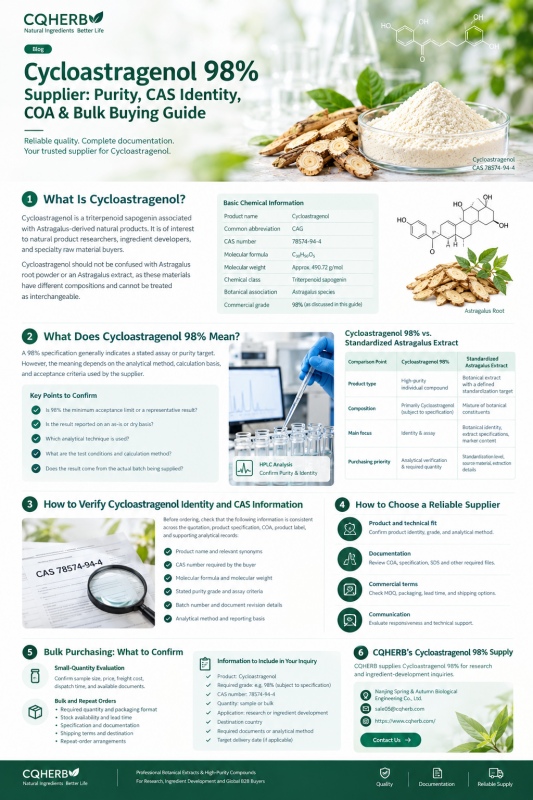
Cycloastragenol is a triterpenoid sapogenin associated with Astragalus-derived natural products. It is described in chemical databases as an aglycone related to astragaloside IV.
The compound is of interest in natural product chemistry and research involving botanical constituents. For ingredient buyers, its value begins with establishing the correct chemical identity and obtaining material that meets a clearly defined specification.
Cycloastragenol should not be confused with Astragalus root powder, an Astragalus extract, or an astragaloside-standardized extract. These materials have different compositions and cannot be treated as interchangeable solely because they are associated with the same botanical source.
|
Property |
Information |
|
Product name |
Cycloastragenol |
|
Common abbreviation |
CAG |
|
CAS number commonly listed |
78574-94-4 |
|
Molecular formula |
C₃₀H₅₀O₅ |
|
Molecular weight |
Approximately 490.72 g/mol |
|
Chemical class |
Triterpenoid sapogenin |
|
Botanical association |
Astragalus species |
|
Commercial grade discussed in this guide |
98% |
|
Analytical documentation |
Confirm the current specification and available batch records with the supplier |
Public chemical references list Cycloastragenol under CAS 78574-94-4, with molecular formula C₃₀H₅₀O₅ and a molecular weight of approximately 490.72 g/mol. Buyers should independently verify the identity required for their project and ensure that the supplier's documentation matches it.
Reference: PubChem, Cycloastragenol. https://pubchem.ncbi.nlm.nih.gov/compound/13943286
Cycloastragenol 98% generally indicates a material grade with a stated assay or purity target of 98%. However, the meaning of that number depends on the specification and analytical procedure used.
Before comparing quotations, buyers should clarify the following:
Is 98% the minimum acceptance limit or a representative result?
Is the result reported on an as-is basis or a dry basis?
Which analytical technique is used?
What are the applicable test conditions and calculation method?
Does the reported value come from the actual batch being supplied?
Are relevant impurities and other quality attributes evaluated separately?
A reported assay result should not automatically be interpreted as proof of every aspect of material quality. For example, a purity result does not by itself establish compliance with microbiological limits, residual-solvent requirements, heavy-metal specifications, or the requirements of a particular finished product.
|
Comparison point |
Cycloastragenol 98% |
Standardized Astragalus extract |
|
Product type |
High-purity individual compound |
Botanical extract with a defined standardization target |
|
Composition |
Intended to be predominantly Cycloastragenol |
Contains a mixture of botanical constituents |
|
Main specification focus |
Compound identity and assay |
Botanical identity, extract specifications, and marker content |
|
Documentation priorities |
Identity, assay method, batch results |
Botanical source, extract details, marker assay, and batch results |
|
Purchasing considerations |
Analytical verification and required quantity |
Standardization level, source material, extraction details, and intended use |
These product types serve different procurement purposes. Buyers should select the material based on the actual project specification rather than comparing their prices or percentages as if they represented the same product.
Chemical identity is a basic requirement when sourcing a high-purity compound. A mismatch in product name, CAS number, or specification can create problems during laboratory evaluation, internal quality review, and purchasing approval.
Before ordering, check that the following information is consistent across the quotation, product specification, COA, product label, and any supporting analytical records:
Product name and relevant synonyms.
CAS number required by the buyer.
Molecular formula and molecular weight, where applicable.
Stated purity grade and assay acceptance criteria.
Batch number and document revision details.
Analytical method and reporting basis.
If a buyer's internal specification or database lists a different CAS number, do not assume that the discrepancy is unimportant. Ask the supplier and the buyer's technical team to resolve the identity requirement before purchase.
The same principle applies to product descriptions that use terms such as “natural,” “botanical,” or “high purity.” Such terms do not replace the need for clear identity and quality documentation.
Analytical data are important when comparing Cycloastragenol suppliers. However, the phrase “HPLC tested” does not fully describe a method or establish that two suppliers' results are directly comparable.
1. Analytical technique
Ask which technique was used for the assay and whether the method is appropriate for the compound and the intended measurement. Depending on the analytical characteristics of a substance, the detection system and sample preparation can affect the result.
2. Method details
Where available and appropriate, review the method reference, column, mobile phase, detector, sample preparation, and calculation procedure. Do not assume that every supplier uses the same method simply because both report an HPLC result.
3. Chromatographic evidence
When chromatograms are available, check whether the report identifies the relevant peak and provides enough information for the intended review. A chromatogram is supporting evidence, not an automatic guarantee of identity or complete impurity characterization.
4. Batch traceability
Confirm that the analytical report relates to the batch quoted or supplied. A generic specification sheet and a batch-specific COA serve different purposes.
5. Independent verification
For projects requiring stronger supplier qualification, buyers may arrange independent testing using an agreed method and acceptance criteria.
Results from different analytical methods may not be directly comparable. A sound supplier evaluation therefore considers both the reported number and the procedure used to obtain it.
For Cycloastragenol, buyers with demanding analytical requirements should discuss method suitability and the available supporting evidence with the supplier before relying on a percentage figure alone.
CQHERB recommends that customers communicate their required assay method or internal specification at the inquiry stage so that the proposed material and available documentation can be evaluated against the project's needs.
A Certificate of Analysis (COA) records the test results for a particular material or batch against defined specifications. Its usefulness depends on whether it clearly identifies the material and documents the relevant quality checks.
When reviewing a Cycloastragenol COA, buyers should look for the following information where applicable:
|
COA item |
What to check |
|
Product name |
Does it match the ordered material? |
|
Batch or lot number |
Can the tested material be traced to the supplied batch? |
|
Test item |
Are the required quality attributes listed? |
|
Specification or acceptance limit |
Is the criterion clearly stated? |
|
Test method |
Is the method identified where needed? |
|
Result |
Is the reported result clear and interpretable? |
|
Test or issue date |
Is the document current for the batch under review? |
|
Authorized release information |
Is the document appropriately approved by the supplier? |
The exact content of a COA varies by product specification and supplier quality system. Additional documents may be needed depending on the intended market, application, and buyer qualification procedure.
COA: Records analytical results for an identified batch.
Product specification or TDS: Describes defined product attributes, acceptance criteria, and technical information.
SDS: Provides safety information relevant to handling, storage, exposure control, and emergency response.
These documents are complementary rather than interchangeable. Buyers should request the documents relevant to their project and confirm availability before placing an order.
A competitive price is useful, but it should not be the only factor in supplier selection. Buyers need to assess whether the offered material, documentation, and supply arrangements meet their requirements.
Product and technical fit
Can the supplier confirm the exact product identity and required grade?
Is the stated purity supported by an appropriate analytical method?
Are the specification and available batch documents clear?
Can the supplier explain any limitations in the offered grade?
Commercial fit
What quantities are available for evaluation and bulk purchasing?
Is there a minimum order quantity?
Are sample costs and freight quoted separately?
What are the packaging options and estimated lead time?
Can the supplier discuss repeat-order availability?
Documentation and communication
Can the supplier provide the documents actually available for the offered batch?
Are product claims consistent with the supporting records?
Can the supplier clarify the proposed shipping terms and destination requirements?
Is the supplier responsive to technical and purchasing questions?
For a more efficient qualification process, buyers can send a concise list of questions:
What Cycloastragenol grade and assay specification are available?
Which CAS number is stated in the product documentation?
Which method is used for the purity assay?
Can you provide the current specification and a representative or batch-specific COA, as appropriate?
What sample quantities and bulk quantities can you supply?
What are the MOQ, packaging, lead time, and shipping options?
Which additional documents are available for the intended application?
Clear answers help buyers compare suppliers on a like-for-like basis and reduce misunderstandings before an order is placed.
Bulk procurement requires more than confirming the price per kilogram. The buyer and supplier should agree on the grade, quantity, batch documentation, delivery arrangements, and acceptance requirements.
For initial evaluation, confirm the available sample size, sample price, freight cost, expected dispatch time, and documents that can accompany the sample.
If the material will be tested by an external laboratory, agree on the test method and acceptance criteria before testing. This makes the results easier to interpret and compare.
For larger purchases, confirm:
Required quantity and packaging format.
Whether the quoted material is currently in stock or subject to production.
Batch availability and expected lead time.
Applicable specification and documentation.
Shipping terms, destination, and freight arrangements.
How future batches will be reviewed against the agreed requirements.
For repeat procurement, buyers should establish a written specification and a consistent batch-review process rather than relying only on the wording of an earlier quotation.
To receive a more accurate quotation, provide the supplier with:
Product: Cycloastragenol
Required grade: for example, 98%, subject to the agreed specification
CAS number required by your project
Quantity: sample, grams, kilograms, or planned annual demand
Intended application and relevant technical requirements
Destination country
Required documents or analytical method
Target delivery date, if applicable
The more clearly these requirements are defined, the easier it is for the supplier to determine whether the available material is a suitable match.
CQHERB supplies botanical raw materials and high-purity compounds for B2B customers involved in ingredient sourcing, research, and formulation development.
For buyers evaluating Cycloastragenol 98%, CQHERB can discuss the requested grade, order quantity, available product information, and applicable purchasing arrangements.
Before confirming an order, buyers should communicate their required chemical identity, assay specification, quantity, destination, and documentation needs. The proposed material and the available batch records can then be reviewed against those requirements.
To inquire about Cycloastragenol 98%, please contact CQHERB:
Company: Nanjing Spring & Autumn Biological Engineering Co., Ltd.
Email: sale05@cqherb.com
Website: https://www.cqherb.com/
Please include your required quantity, destination country, and any specific analytical or documentation requirements in your inquiry.
CAS 78574-94-4 is commonly listed for Cycloastragenol in public chemical references. Buyers should confirm that the CAS number in the supplier's documentation matches the exact identity required for their project.
It generally describes a grade with a stated assay or purity target of 98%. Buyers should confirm the acceptance limit, analytical method, reporting basis, and batch result before comparing offers.
A COA is an important part of supplier qualification, but it should be reviewed alongside the product specification, analytical method, batch traceability, and any additional quality requirements relevant to the intended application.
If analytical verification is important to your project, ask which method is used and what supporting data are available. Review the method and results against your own technical requirements rather than relying on the term “HPLC tested” alone.
Cycloastragenol is an individual compound, whereas an Astragalus extract contains a mixture of botanical constituents. An extract standardized to a particular marker is not automatically equivalent to a high-purity Cycloastragenol product.
Bulk availability, minimum order quantity, packaging, lead time, and pricing depend on the supplier's current offering and the requested grade. Send the required quantity and destination to obtain a quotation based on your needs.
Commonly requested documents include a product specification or TDS, a batch-specific COA when available, and an SDS. Other documents may be needed depending on the buyer's quality system, application, and destination market.
Email sale05@cqherb.com with your required grade, quantity, destination country, and analytical or documentation requirements. CQHERB can review the inquiry and confirm the relevant product and commercial details.
Selecting a Cycloastragenol 98% supplier requires a structured review of chemical identity, assay methodology, batch documentation, and commercial supply arrangements.
For buyers comparing suppliers, the most useful starting point is a clear specification supported by relevant analytical information. Confirm the requirements before requesting samples or placing a bulk order, and ensure that the offered material matches the intended project.
For Cycloastragenol 98% sourcing inquiries, contact CQHERB at sale05@cqherb.com.
PubChem. Cycloastragenol: chemical identity, molecular formula, and molecular weight. https://pubchem.ncbi.nlm.nih.gov/compound/13943286
Sigma-Aldrich. Cycloastragenol, ≥98% (HPLC): product information and listed chemical properties. https://www.sigmaaldrich.com/PA/en/product/sigma/sml1448
Note: Public chemical references provide background information. Product-specific specifications, analytical methods, batch results, and document availability should be confirmed with the supplier before purchase.



 IPv6 network supported