banner

Cordycepin Manufacturer

Home

Cordycepin Manufacturer

  • Why Is Cordycepin Receiving Increasing Scientific Attention? Structure, Sources & Research Overview (2026)
    Why Is Cordycepin Receiving Increasing Scientific Attention? Structure, Sources & Research Overview (2026)
    Jul 21, 2026
    Understanding Cordycepin: Why It Has Become One of the Most Important Bioactive Compounds from Cordyceps militaris Quick Summary The growing interest in Cordycepin is driven not only by scientific research but also by advances in cultivation technology, fermentation processes, analytical methods, and the increasing demand for standardized botanical ingredients. Today, high-purity Cordycepin has become an important research material and industrial ingredient because it combines a well-defined molecular structure with reproducible quality and scalable production. 2. Why Has Cordycepin Become One of the Most Studied Natural Compounds? Over the past two decades, Cordycepin has evolved from a relatively specialized natural compound into one of the most recognized bioactive constituents derived from Cordyceps militaris. This transformation reflects broader developments in biotechnology, analytical chemistry, and the global botanical ingredients industry. Unlike many botanical extracts that consist of complex mixtures of naturally occurring compounds, Cordycepin can be isolated, purified, and characterized as a single molecule. This allows researchers and manufacturers to work with a material whose identity and purity can be consistently verified using established analytical methods such as High-Performance Liquid Chromatography (HPLC). As scientific interest in standardized botanical compounds continues to expand, Cordycepin has become increasingly important in natural product chemistry, biotechnology, formulation development, food science, cosmetic ingredient research, and laboratory applications. Rather than being driven by a single discovery, the growing attention surrounding Cordycepin is the result of several long-term trends that continue to shape the botanical extract industry. Four Key Factors Driving Global Interest 1. Advances in Cultivation and Fermentation Technology Modern cultivation systems for Cordyceps militaris have significantly improved production efficiency and consistency. Controlled fermentation environments enable manufacturers to obtain reliable raw materials while supporting scalable commercial production. 2. Demand for Standardized Botanical Ingredients Global manufacturers increasingly prefer ingredients with clearly defined specifications, traceable production processes, and comprehensive analytical documentation. High-purity Cordycepin aligns well with these expectations. 3. Progress in Analytical Technologies Analytical techniques such as HPLC, LC-MS, and NMR have made it possible to accurately identify, quantify, and verify Cordycepin. These tools support product standardization and improve confidence in quality evaluation. 4. Expanding Scientific Research Research involving Cordycepin now spans multiple scientific disciplines, contributing to a growing body of literature and increasing demand for high-quality research materials. Why Do Researchers Prefer High-Purity Cordycepin? For many scientific and industrial applications, consistency is just as important as purity. High-purity Cordycepin (typically ≥98% by HPLC) helps minimize variability between experiments and supports reliable analytical results. Researchers often prefer standardized materials because they provide: Clearly defined chemical identity High batch-to-batch consistency Improved analytical reproducibility Easier formulation development Better traceability throughout the supply chain Comprehensive technical documentation These characteristics make high-purity Cordycepin particularly suitable for laboratories, formulation scientists, and manufacturers requiring reproducible materials. Scientific Milestones in Cordycepin Development Period Development 1950s Initial identification of Cordycepin from fungi belonging to the Cordyceps genus 1980s–1990s Improvements in isolation and analytical characterization Early 2000s Expansion of cultivation techniques for Cordyceps militaris 2010s Advances in submerged fermentation and purification technologies Today Commercial availability of standardized high-purity Cordycepin for research and industrial applications This progression illustrates how advances in biotechnology and quality control have transformed Cordycepin into a widely recognized botanical ingredient. CQHERB Technical Insight From a manufacturing perspective, the commercial success of Cordycepin depends not only on its natural origin but also on the ability to produce it consistently. Controlled cultivation, optimized fermentation, and rigorous purification are essential for achieving high purity and reliable batch-to-batch quality. Comprehensive analytical testing—including HPLC purity, identity confirmation, residual solvents, heavy metals, and microbiological limits—provides a more complete evaluation than purity alone. Industry Insight The botanical ingredients industry is moving toward well-characterized compounds supported by transparent production processes and standardized specifications. Cordycepin reflects this broader trend, as manufacturers and researchers increasingly prioritize reproducibility, traceability, and technical documentation when selecting botanical ingredients. Section Summary The growing importance of Cordycepin is driven by advances in biotechnology, analytical science, and the demand for standardized botanical ingredients. Its defined molecular identity, scalable production, and reproducible quality have made it a valuable material for research and industrial development. 3. Understanding the Molecular Structure of Cordycepin What Makes Cordycepin Structurally Unique? Cordycepin, also known as 3'-Deoxyadenosine, belongs to the purine nucleoside family. It shares a close structural relationship with adenosine but differs in one important aspect: the hydroxyl (-OH) group at the 3' position of the ribose sugar is absent. Although this modification appears minor, it distinguishes Cordycepin as a unique naturally occurring nucleoside analog and forms the basis for its extensive investigation in natural product chemistry and molecular research. Basic Chemical Information Property Value Chemical Name Cordycepin Synonym 3'-Deoxyadenosine CAS Number 73-03-0 Molecular Formula C₁₀H₁₃N₅O₃ Molecular Weight 251.24 g/mol Appearance White to off-white crystalline powder Typical Commercial Purity ≥98% (HPLC) Cordycepin vs. Adenosine Feature Adenosine Cordycepin Chemical Family Purine nucleoside Purine nucleoside analog 3' Hydroxyl Group Present Absent Natural Occurrence Widely distributed in living organisms Primarily associated with Cordyceps militaris This comparison highlights the structural distinction that has made Cordycepin a focus of scientific investigation. Why Do Physicochemical Properties Matter? Understanding physicochemical properties is essential because they influence: Analytical testing Formulation compatibility Storage conditions Manufacturing consistency Product stability Quality control procedures Rather than serving only as technical specifications, these properties help manufacturers and researchers maintain consistent product performance throughout production and application. Key Definitions Cordycepin – A naturally occurring nucleoside analog (3'-Deoxyadenosine) primarily obtained from Cordyceps militaris. Nucleoside – A molecule consisting of a nitrogenous base linked to a sugar, serving as a fundamental component in many biological systems. HPLC – High-Performance Liquid Chromatography, an analytical technique widely used to verify identity and purity. Purity – The proportion of the target compound relative to total detectable components, commonly expressed as a percentage determined by validated analytical methods. Section Summary Cordycepin possesses a clearly defined molecular structure that distinguishes it from adenosine and supports accurate analytical characterization. These characteristics contribute to its value as a standardized botanical compound. 4. Where Does Commercial Cordycepin Come From? One of the most common misconceptions is that commercial Cordycepin is obtained directly from wild Cordyceps sinensis. In reality, the vast majority of high-purity Cordycepin available today is produced from cultivated Cordyceps militaris. Cultivated production offers significant advantages over wild resources, including greater sustainability, improved quality consistency, and better traceability throughout the manufacturing process. Why Is Cordyceps militaris the Preferred Source? Compared with wild fungal resources, cultivated Cordyceps militaris provides: Controlled cultivation conditions Stable raw material supply Better batch consistency Higher production efficiency Compatibility with industrial fermentation Sustainable resource utilization These advantages have made Cordyceps militaris the preferred commercial source for standardized Cordycepin production. From Mushroom to High-Purity Cordycepin Commercial production generally involves the following stages: Strain selection Controlled cultivation or submerged fermentation Biomass harvesting Extraction Purification Chromatographic separation Crystallization HPLC quality verification Packaging Each stage contributes to the production of a standardized ingredient with defined specifications and reproducible quality. CQHERB Technical Insight A reliable Cordycepin supplier should be able to provide not only a high-purity product but also comprehensive technical documentation, including COA, HPLC chromatograms, specifications, residual solvent information, and other quality records that support traceability and batch consistency. Section Summary   Modern commercial Cordycepin is primarily produced from cultivated Cordyceps militaris using controlled cultivation, purification, and analytical verification. This production approach supports sustainability, standardized quality, and reliable supply for research and industrial applications.
    Read More
  • The Ultimate Guide to Cordycepin (98%) in 2026
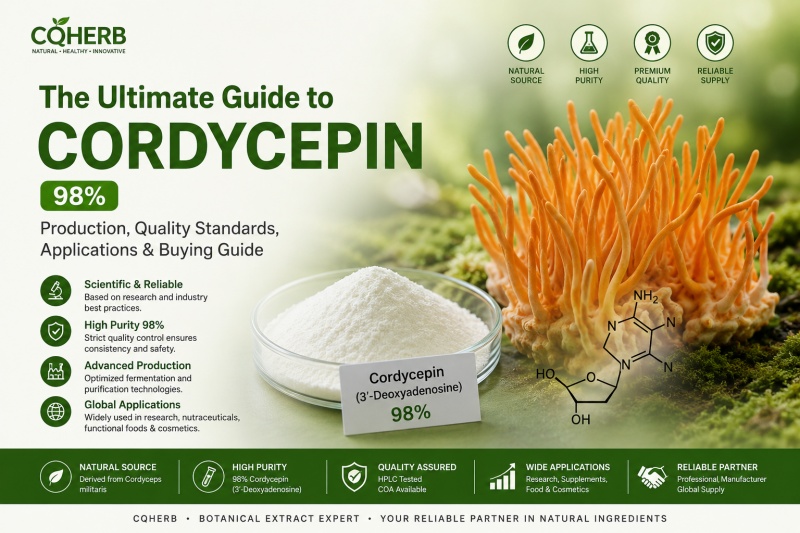
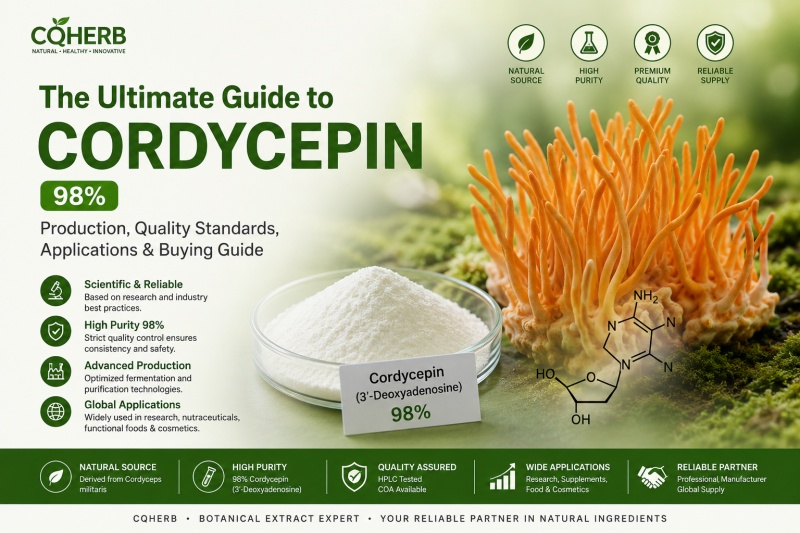
    The Ultimate Guide to Cordycepin (98%) in 2026
    Jul 20, 2026
    Cordycepin (98%) Ultimate Guide Production • Quality Standards • Scientific Research • Industry Applications • Supplier Selection Building Reliable Knowledge for Researchers, Manufacturers, and Global Buyers Cordycepin (3'-Deoxyadenosine) is one of the most extensively studied bioactive compounds naturally found in Cordyceps militaris. With increasing interest from the nutraceutical, functional food, cosmetic, and scientific research sectors, high-purity Cordycepin has become an important ingredient for laboratories and manufacturers seeking standardized, well-characterized botanical compounds. This guide summarizes current scientific knowledge and industry practices surrounding 98% Cordycepin, including its natural sources, production technologies, physicochemical characteristics, quality evaluation, and purchasing considerations. CTA Looking for a reliable manufacturer of high-purity Cordycepin? Request Technical Documents COA | Specification | HPLC Chromatogram | MSDS | Sample Availability Quick Answer What Is Cordycepin? Cordycepin (CAS No. 73-03-0), also known as 3'-Deoxyadenosine, is a naturally occurring nucleoside analog first isolated from species within the Cordyceps genus. Today, it is most commonly produced from cultivated Cordyceps militaris through optimized fermentation and purification technologies, enabling the manufacture of high-purity materials suitable for scientific research and industrial applications. Because of its distinctive chemical structure, Cordycepin has attracted extensive attention in biochemical, pharmacological, and food science research. Researchers have investigated its physicochemical characteristics, biological interactions, and potential applications in areas such as nutraceutical development, functional food ingredients, cosmetic formulations, and laboratory studies. While research is active and expanding, the practical use of Cordycepin should always be evaluated within the relevant regulatory framework and intended application. Commercially, Cordycepin is available in multiple purity grades. High-purity 98% Cordycepin is generally selected for research institutions, formulation development, analytical laboratories, and manufacturers requiring standardized quality and batch-to-batch consistency. Quality assessment typically includes HPLC purity, identity testing, residual solvent analysis, heavy metals, microbiological limits, and other specifications depending on the intended use. As global demand for standardized botanical ingredients continues to grow, understanding how Cordycepin is produced, characterized, and evaluated has become increasingly important for researchers, product developers, and procurement professionals. Key Takeaways Cordycepin is a naturally occurring nucleoside analog known chemically as 3'-Deoxyadenosine. It is primarily associated with Cordyceps militaris and is commonly obtained through controlled cultivation and purification processes. High-purity (98%) Cordycepin is widely used in scientific research and formulation development where standardized quality is essential. Quality evaluation typically includes HPLC purity, identity confirmation, residual solvents, heavy metals, and microbiological testing. Production technology has evolved from simple extraction toward optimized fermentation and downstream purification. Different application sectors require different quality specifications and documentation. Reliable suppliers should provide comprehensive technical documents such as COA, specifications, chromatograms, and safety data sheets. Understanding stability and storage conditions is important for maintaining product quality. Scientific literature on Cordycepin continues to expand across multiple research disciplines. Selecting a qualified manufacturer can help improve consistency, traceability, and technical support. Table of Contents What Is Cordycepin? Why Has Cordycepin Received Increasing Scientific Attention? Chemical Structure and Physicochemical Properties Natural Sources of Cordycepin How Is High-Purity Cordycepin Produced? Quality Standards and Analytical Methods Applications in Research and Industry How to Evaluate Cordycepin Quality Buying Guide for Global Manufacturers Frequently Asked Questions Scientific References 1. What Is Cordycepin? Cordycepin is a naturally occurring nucleoside analog chemically identified as 3'-Deoxyadenosine. Structurally, it is closely related to adenosine, differing by the absence of the hydroxyl group at the 3' position of the ribose sugar. This subtle structural variation has made Cordycepin an important subject of investigation across multiple scientific disciplines, including natural product chemistry, molecular biology, biotechnology, and food science. Originally identified from fungi belonging to the Cordyceps genus, Cordycepin is now primarily associated with Cordyceps militaris, a cultivated medicinal mushroom widely recognized as a commercially sustainable source of this compound. Advances in cultivation techniques and fermentation technologies have significantly improved production efficiency, enabling the availability of high-purity Cordycepin for research and industrial use. Unlike crude mushroom powders or standard mushroom extracts, purified Cordycepin represents a single, chemically characterized compound. This distinction is particularly important for analytical laboratories, formulation scientists, and manufacturers who require precise control over ingredient identity, purity, and batch consistency. Today, high-purity Cordycepin is supplied to universities, research institutes, dietary supplement developers, cosmetic manufacturers, and biotechnology companies worldwide. As interest in standardized botanical ingredients continues to grow, Cordycepin has become one of the most recognized marker compounds derived from Cordyceps militaris. Definition Cordycepin (3'-Deoxyadenosine) is a naturally occurring nucleoside analog isolated primarily from Cordyceps militaris. Commercial high-purity Cordycepin is produced through controlled cultivation, fermentation, extraction, and purification processes and is widely used as a standardized research material and industrial botanical ingredient. CQHERB Technical Insight One common misunderstanding in the market is treating Cordyceps militaris extract and 98% Cordycepin as interchangeable products. In reality, they serve different purposes and are manufactured to different quality specifications. A Cordyceps militaris extract is a complex botanical preparation containing multiple naturally occurring constituents, with Cordycepin representing only one of many compounds. By contrast, 98% Cordycepin is a highly purified single compound that undergoes additional separation and purification steps to achieve a standardized purity level. For applications requiring precise formulation, analytical testing, or reproducible research conditions, high-purity Cordycepin is generally preferred because it offers greater consistency and more clearly defined quality attributes than a conventional mushroom extract. Industry Insight In recent years, global interest in standardized mushroom-derived ingredients has shifted from broad-spectrum extracts toward well-characterized marker compounds with defined specifications. This trend reflects the increasing demand from research institutions and manufacturers for ingredients that provide consistent analytical data, traceable production processes, and comprehensive quality documentation. As production technologies continue to improve, high-purity botanical monomers such as Cordycepin are expected to play an increasingly important role in product development, quality control, and scientific research. Summary   Cordycepin is more than a naturally occurring constituent of Cordyceps militaris—it is a well-characterized botanical compound with defined chemical identity, standardized quality requirements, and growing importance in research and industrial development. Understanding its origin, structure, and production forms the foundation for evaluating its quality and appropriate applications.
    Read More

leave a message

leave a message
If you are interested in our products and want to know more details,please leave a message here,we will reply you as soon as we can.
submit

home

products

WhatsApp

contact