English



What Are You Looking For?

Building Reliable Knowledge for Researchers, Manufacturers, and Global Buyers
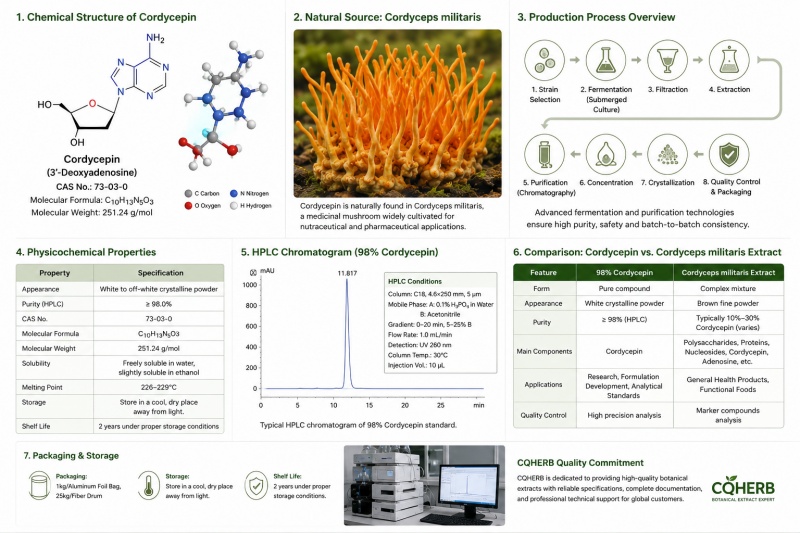
Cordycepin (3'-Deoxyadenosine) is one of the most extensively studied bioactive compounds naturally found in Cordyceps militaris. With increasing interest from the nutraceutical, functional food, cosmetic, and scientific research sectors, high-purity Cordycepin has become an important ingredient for laboratories and manufacturers seeking standardized, well-characterized botanical compounds.
This guide summarizes current scientific knowledge and industry practices surrounding 98% Cordycepin, including its natural sources, production technologies, physicochemical characteristics, quality evaluation, and purchasing considerations.
CTA
Looking for a reliable manufacturer of high-purity Cordycepin?
Request Technical Documents
COA | Specification | HPLC Chromatogram | MSDS | Sample Availability

Cordycepin (CAS No. 73-03-0), also known as 3'-Deoxyadenosine, is a naturally occurring nucleoside analog first isolated from species within the Cordyceps genus. Today, it is most commonly produced from cultivated Cordyceps militaris through optimized fermentation and purification technologies, enabling the manufacture of high-purity materials suitable for scientific research and industrial applications.
Because of its distinctive chemical structure, Cordycepin has attracted extensive attention in biochemical, pharmacological, and food science research. Researchers have investigated its physicochemical characteristics, biological interactions, and potential applications in areas such as nutraceutical development, functional food ingredients, cosmetic formulations, and laboratory studies. While research is active and expanding, the practical use of Cordycepin should always be evaluated within the relevant regulatory framework and intended application.
Commercially, Cordycepin is available in multiple purity grades. High-purity 98% Cordycepin is generally selected for research institutions, formulation development, analytical laboratories, and manufacturers requiring standardized quality and batch-to-batch consistency. Quality assessment typically includes HPLC purity, identity testing, residual solvent analysis, heavy metals, microbiological limits, and other specifications depending on the intended use.
As global demand for standardized botanical ingredients continues to grow, understanding how Cordycepin is produced, characterized, and evaluated has become increasingly important for researchers, product developers, and procurement professionals.
Cordycepin is a naturally occurring nucleoside analog chemically identified as 3'-Deoxyadenosine. Structurally, it is closely related to adenosine, differing by the absence of the hydroxyl group at the 3' position of the ribose sugar. This subtle structural variation has made Cordycepin an important subject of investigation across multiple scientific disciplines, including natural product chemistry, molecular biology, biotechnology, and food science.
Originally identified from fungi belonging to the Cordyceps genus, Cordycepin is now primarily associated with Cordyceps militaris, a cultivated medicinal mushroom widely recognized as a commercially sustainable source of this compound. Advances in cultivation techniques and fermentation technologies have significantly improved production efficiency, enabling the availability of high-purity Cordycepin for research and industrial use.
Unlike crude mushroom powders or standard mushroom extracts, purified Cordycepin represents a single, chemically characterized compound. This distinction is particularly important for analytical laboratories, formulation scientists, and manufacturers who require precise control over ingredient identity, purity, and batch consistency.
Today, high-purity Cordycepin is supplied to universities, research institutes, dietary supplement developers, cosmetic manufacturers, and biotechnology companies worldwide. As interest in standardized botanical ingredients continues to grow, Cordycepin has become one of the most recognized marker compounds derived from Cordyceps militaris.
Cordycepin (3'-Deoxyadenosine) is a naturally occurring nucleoside analog isolated primarily from Cordyceps militaris. Commercial high-purity Cordycepin is produced through controlled cultivation, fermentation, extraction, and purification processes and is widely used as a standardized research material and industrial botanical ingredient.
One common misunderstanding in the market is treating Cordyceps militaris extract and 98% Cordycepin as interchangeable products. In reality, they serve different purposes and are manufactured to different quality specifications.
A Cordyceps militaris extract is a complex botanical preparation containing multiple naturally occurring constituents, with Cordycepin representing only one of many compounds. By contrast, 98% Cordycepin is a highly purified single compound that undergoes additional separation and purification steps to achieve a standardized purity level.
For applications requiring precise formulation, analytical testing, or reproducible research conditions, high-purity Cordycepin is generally preferred because it offers greater consistency and more clearly defined quality attributes than a conventional mushroom extract.
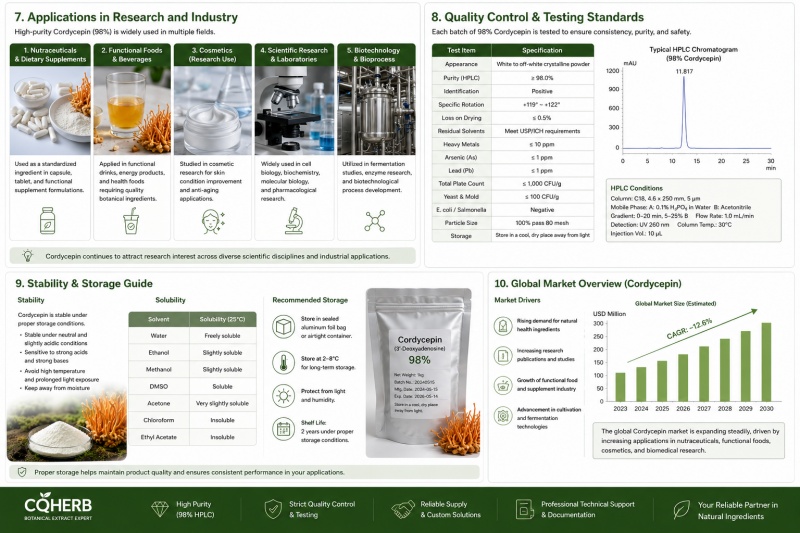
In recent years, global interest in standardized mushroom-derived ingredients has shifted from broad-spectrum extracts toward well-characterized marker compounds with defined specifications. This trend reflects the increasing demand from research institutions and manufacturers for ingredients that provide consistent analytical data, traceable production processes, and comprehensive quality documentation.
As production technologies continue to improve, high-purity botanical monomers such as Cordycepin are expected to play an increasingly important role in product development, quality control, and scientific research.
Cordycepin is more than a naturally occurring constituent of Cordyceps militaris—it is a well-characterized botanical compound with defined chemical identity, standardized quality requirements, and growing importance in research and industrial development. Understanding its origin, structure, and production forms the foundation for evaluating its quality and appropriate applications.



 IPv6 network supported