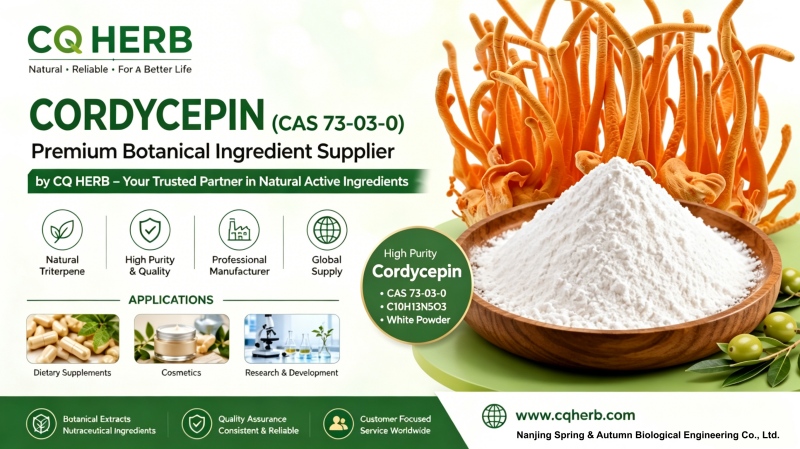
banner

Cordycepin

Home

Cordycepin

  • Cordycepin Production, Quality Standards & Industrial Applications
    Cordycepin Production, Quality Standards & Industrial Applications
    Jul 24, 2026
    Part 3 Cordycepin Production, Quality Standards & Industrial Applications From Cultivation to High-Purity Cordycepin (98%) Quick Summary The production of high-purity Cordycepin requires a combination of biological cultivation technology, extraction expertise, purification processes, and rigorous analytical testing. Unlike simple botanical extracts, 98% Cordycepin represents a highly standardized single compound that requires precise control throughout the entire manufacturing process. For global buyers, evaluating Cordycepin quality involves more than checking purity percentage. A reliable assessment should include raw material traceability, production technology, analytical methods, HPLC chromatograms, COA documentation, residual solvent testing, and batch consistency. As demand for standardized natural compounds continues to grow, high-purity Cordycepin has become increasingly important across scientific research, biotechnology, nutraceutical development, functional ingredients, and other emerging applications. 6. How Is High-Purity Cordycepin (98%) Produced? Overview of Commercial Production Commercial Cordycepin production has evolved significantly from traditional fungal extraction methods toward more controlled and scalable manufacturing approaches. Today, high-purity Cordycepin is generally obtained from cultivated Cordyceps militaris through a combination of: Controlled cultivation Fermentation technology Extraction optimization Purification processes Analytical verification The goal of production is not only to achieve high purity but also to ensure: Consistent quality Reliable supply Batch reproducibility Traceable manufacturing records Main Production Process of Cordycepin 1. Strain Selection and Cultivation The production process begins with carefully selected Cordyceps militaris strains. Important factors include: Growth characteristics Cordycepin production capability Cultivation stability Microbial control Compared with wild fungal resources, cultivated strains provide better control over raw material quality and production consistency. 2. Cultivation and Fermentation Modern production may utilize controlled cultivation systems or fermentation technologies designed to optimize biomass growth and target compound production. Key parameters include: Temperature control Nutrient composition Fermentation conditions Cultivation time Environmental monitoring Controlled production conditions help improve reproducibility between different batches. 3. Extraction Process After cultivation, the biomass undergoes extraction to obtain Cordycepin-containing fractions. Extraction parameters may influence: Extraction efficiency Compound stability Impurity profile Downstream purification requirements A well-designed extraction process is essential for maintaining product quality. 4. Purification and Refinement Crude extracts contain multiple natural compounds. Therefore, additional purification steps are required to obtain high-purity Cordycepin. Typical purification stages include: Separation of unwanted components Concentration Purification Crystallization Drying The final objective is achieving a standardized Cordycepin product meeting the required purity specification. 5. Quality Testing and Release Before shipment, each batch should undergo analytical verification. Typical quality evaluation includes: Test Item Purpose HPLC Purity Determine Cordycepin content Identity Testing Confirm compound identity Appearance Visual quality evaluation Moisture Stability assessment Residual Solvents Safety evaluation Heavy Metals Contaminant control Microbiological Testing Quality assurance   CQHERB Technical Insight For high-purity botanical compounds, manufacturing capability is not determined only by extraction technology. A qualified supplier should have a complete quality management approach covering raw materials, production control, analytical verification, documentation, and customer technical support. For Cordycepin 98%, analytical transparency is especially important because purity alone does not fully describe product quality. Supporting documentation such as HPLC chromatograms, specifications, and batch records provides greater confidence for international buyers. 7. Understanding Cordycepin Quality Standards Why Is Purity Important? Purity is one of the most commonly evaluated parameters when purchasing Cordycepin. A product labeled as: Cordycepin 50% Cordycepin 90% Cordycepin 98% represents different levels of refinement and different application requirements. High-purity Cordycepin (98%) is typically selected when users require: Defined chemical composition Analytical consistency Research reproducibility Standardized formulation materials Key Quality Parameters for 98% Cordycepin 1. HPLC Purity High-Performance Liquid Chromatography (HPLC) is one of the most widely used methods for determining Cordycepin purity. A typical HPLC report provides: Retention time Peak identification Purity percentage Chromatographic profile For buyers, reviewing the HPLC chromatogram is an important step in supplier evaluation. 2. Identity Confirmation Identity testing ensures that the material supplied is truly Cordycepin. Common analytical approaches include: HPLC comparison LC-MS NMR analysis 3. Residual Solvent Testing Depending on the production process, residual solvent analysis may be required to verify compliance with applicable standards. 4. Heavy Metals and Microbiological Control Quality-focused suppliers should monitor: Lead Arsenic Mercury Cadmium as well as microbiological parameters when applicable. Buyer Checklist: How to Evaluate Cordycepin Quality Before purchasing, buyers should consider: ✅ Is HPLC purity clearly provided? ✅ Is a COA available? ✅ Is the manufacturing source transparent? ✅ Are analytical methods documented? ✅ Is batch consistency demonstrated? ✅ Are technical documents available? Recommended supplier documents: COA Specification Sheet HPLC Chromatogram MSDS/SDS Technical Data Sheet 8. Industrial Applications of High-Purity Cordycepin Research Applications Cordycepin is widely used as a research compound in areas including: Natural product chemistry Molecular biology Biotechnology research Analytical studies Because purified Cordycepin provides a defined chemical structure, it is valuable for laboratory studies requiring standardized materials. Nutraceutical Ingredient Development The growing consumer interest in mushroom-derived ingredients has increased demand for standardized Cordyceps-related compounds. Compared with general mushroom powders, purified Cordycepin offers manufacturers a more clearly defined ingredient profile. Applications may include: Ingredient research Formula development Standardization studies Functional Food Research Cordycepin is also studied within the broader field of functional food ingredients derived from natural sources. Manufacturers evaluating Cordycepin typically focus on: Ingredient identity Quality consistency Regulatory requirements Documentation support Cosmetic Ingredient Research Natural compounds derived from fungi and botanical sources have attracted increasing attention in cosmetic science. Cordycepin-related research continues to be explored within the broader natural ingredient research field. For cosmetic developers, important considerations include: Purity Stability Compatibility Safety documentation Industry Insight The market trend is moving from traditional mushroom extracts toward standardized natural compounds with clearly defined chemical identities. This shift creates increasing demand for ingredients such as: Cordycepin Cordyceps marker compounds Botanical monomers High-purity research materials Companies that can provide both product quality and technical documentation will have stronger advantages in the global ingredient supply chain. 9. How to Choose a Reliable Cordycepin Supplier? Choosing a supplier involves more than comparing prices. A professional evaluation should consider: Manufacturing Capability Reliable suppliers should understand: Raw material sourcing Extraction technology Purification processes Quality control procedures Documentation Support International buyers commonly require: COA Specification SDS Technical documents Analytical reports Quality Consistency A long-term supplier should demonstrate: Stable production Repeatable specifications Reliable communication Technical support CQHERB Buyer Tips When evaluating Cordycepin suppliers, buyers should focus on: 1. Product authenticity Confirm identity and purity through analytical documents. 2. Manufacturing transparency Understand whether the supplier controls production or only distributes products. 3. Technical support A professional supplier should be able to answer questions regarding: Production Testing Storage Documentation 4. Long-term cooperation ability Stable supply capability is especially important for commercial projects. Section Summary High-purity Cordycepin production requires a combination of cultivation expertise, purification technology, and rigorous quality control. For international buyers, selecting a reliable supplier involves evaluating not only purity but also analytical documentation, manufacturing capability, and long-term supply reliability. As the global market continues to move toward standardized botanical ingredients, Cordycepin represents an important example of how natural compounds can be transformed into high-quality industrial materials.
    Read More
  • The Ultimate Guide to Cordycepin (98%) in 2026
    The Ultimate Guide to Cordycepin (98%) in 2026
    Jul 20, 2026
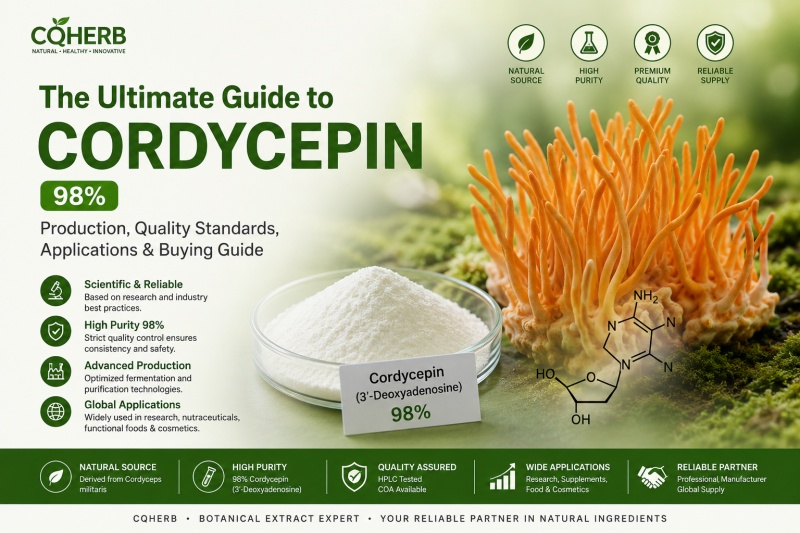
    Cordycepin (98%) Ultimate Guide Production • Quality Standards • Scientific Research • Industry Applications • Supplier Selection Building Reliable Knowledge for Researchers, Manufacturers, and Global Buyers Cordycepin (3'-Deoxyadenosine) is one of the most extensively studied bioactive compounds naturally found in Cordyceps militaris. With increasing interest from the nutraceutical, functional food, cosmetic, and scientific research sectors, high-purity Cordycepin has become an important ingredient for laboratories and manufacturers seeking standardized, well-characterized botanical compounds. This guide summarizes current scientific knowledge and industry practices surrounding 98% Cordycepin, including its natural sources, production technologies, physicochemical characteristics, quality evaluation, and purchasing considerations. CTA Looking for a reliable manufacturer of high-purity Cordycepin? Request Technical Documents COA | Specification | HPLC Chromatogram | MSDS | Sample Availability Quick Answer What Is Cordycepin? Cordycepin (CAS No. 73-03-0), also known as 3'-Deoxyadenosine, is a naturally occurring nucleoside analog first isolated from species within the Cordyceps genus. Today, it is most commonly produced from cultivated Cordyceps militaris through optimized fermentation and purification technologies, enabling the manufacture of high-purity materials suitable for scientific research and industrial applications. Because of its distinctive chemical structure, Cordycepin has attracted extensive attention in biochemical, pharmacological, and food science research. Researchers have investigated its physicochemical characteristics, biological interactions, and potential applications in areas such as nutraceutical development, functional food ingredients, cosmetic formulations, and laboratory studies. While research is active and expanding, the practical use of Cordycepin should always be evaluated within the relevant regulatory framework and intended application. Commercially, Cordycepin is available in multiple purity grades. High-purity 98% Cordycepin is generally selected for research institutions, formulation development, analytical laboratories, and manufacturers requiring standardized quality and batch-to-batch consistency. Quality assessment typically includes HPLC purity, identity testing, residual solvent analysis, heavy metals, microbiological limits, and other specifications depending on the intended use. As global demand for standardized botanical ingredients continues to grow, understanding how Cordycepin is produced, characterized, and evaluated has become increasingly important for researchers, product developers, and procurement professionals. Key Takeaways Cordycepin is a naturally occurring nucleoside analog known chemically as 3'-Deoxyadenosine. It is primarily associated with Cordyceps militaris and is commonly obtained through controlled cultivation and purification processes. High-purity (98%) Cordycepin is widely used in scientific research and formulation development where standardized quality is essential. Quality evaluation typically includes HPLC purity, identity confirmation, residual solvents, heavy metals, and microbiological testing. Production technology has evolved from simple extraction toward optimized fermentation and downstream purification. Different application sectors require different quality specifications and documentation. Reliable suppliers should provide comprehensive technical documents such as COA, specifications, chromatograms, and safety data sheets. Understanding stability and storage conditions is important for maintaining product quality. Scientific literature on Cordycepin continues to expand across multiple research disciplines. Selecting a qualified manufacturer can help improve consistency, traceability, and technical support. Table of Contents What Is Cordycepin? Why Has Cordycepin Received Increasing Scientific Attention? Chemical Structure and Physicochemical Properties Natural Sources of Cordycepin How Is High-Purity Cordycepin Produced? Quality Standards and Analytical Methods Applications in Research and Industry How to Evaluate Cordycepin Quality Buying Guide for Global Manufacturers Frequently Asked Questions Scientific References 1. What Is Cordycepin? Cordycepin is a naturally occurring nucleoside analog chemically identified as 3'-Deoxyadenosine. Structurally, it is closely related to adenosine, differing by the absence of the hydroxyl group at the 3' position of the ribose sugar. This subtle structural variation has made Cordycepin an important subject of investigation across multiple scientific disciplines, including natural product chemistry, molecular biology, biotechnology, and food science. Originally identified from fungi belonging to the Cordyceps genus, Cordycepin is now primarily associated with Cordyceps militaris, a cultivated medicinal mushroom widely recognized as a commercially sustainable source of this compound. Advances in cultivation techniques and fermentation technologies have significantly improved production efficiency, enabling the availability of high-purity Cordycepin for research and industrial use. Unlike crude mushroom powders or standard mushroom extracts, purified Cordycepin represents a single, chemically characterized compound. This distinction is particularly important for analytical laboratories, formulation scientists, and manufacturers who require precise control over ingredient identity, purity, and batch consistency. Today, high-purity Cordycepin is supplied to universities, research institutes, dietary supplement developers, cosmetic manufacturers, and biotechnology companies worldwide. As interest in standardized botanical ingredients continues to grow, Cordycepin has become one of the most recognized marker compounds derived from Cordyceps militaris. Definition Cordycepin (3'-Deoxyadenosine) is a naturally occurring nucleoside analog isolated primarily from Cordyceps militaris. Commercial high-purity Cordycepin is produced through controlled cultivation, fermentation, extraction, and purification processes and is widely used as a standardized research material and industrial botanical ingredient. CQHERB Technical Insight One common misunderstanding in the market is treating Cordyceps militaris extract and 98% Cordycepin as interchangeable products. In reality, they serve different purposes and are manufactured to different quality specifications. A Cordyceps militaris extract is a complex botanical preparation containing multiple naturally occurring constituents, with Cordycepin representing only one of many compounds. By contrast, 98% Cordycepin is a highly purified single compound that undergoes additional separation and purification steps to achieve a standardized purity level. For applications requiring precise formulation, analytical testing, or reproducible research conditions, high-purity Cordycepin is generally preferred because it offers greater consistency and more clearly defined quality attributes than a conventional mushroom extract. Industry Insight In recent years, global interest in standardized mushroom-derived ingredients has shifted from broad-spectrum extracts toward well-characterized marker compounds with defined specifications. This trend reflects the increasing demand from research institutions and manufacturers for ingredients that provide consistent analytical data, traceable production processes, and comprehensive quality documentation. As production technologies continue to improve, high-purity botanical monomers such as Cordycepin are expected to play an increasingly important role in product development, quality control, and scientific research. Summary   Cordycepin is more than a naturally occurring constituent of Cordyceps militaris—it is a well-characterized botanical compound with defined chemical identity, standardized quality requirements, and growing importance in research and industrial development. Understanding its origin, structure, and production forms the foundation for evaluating its quality and appropriate applications.
    Read More
  • CQ HERB Cordycepin 98% Supplier & Manufacturer | Cordycepin CAS 73-03-0
    CQ HERB Cordycepin 98% Supplier & Manufacturer | Cordycepin CAS 73-03-0
    Jun 24, 2026
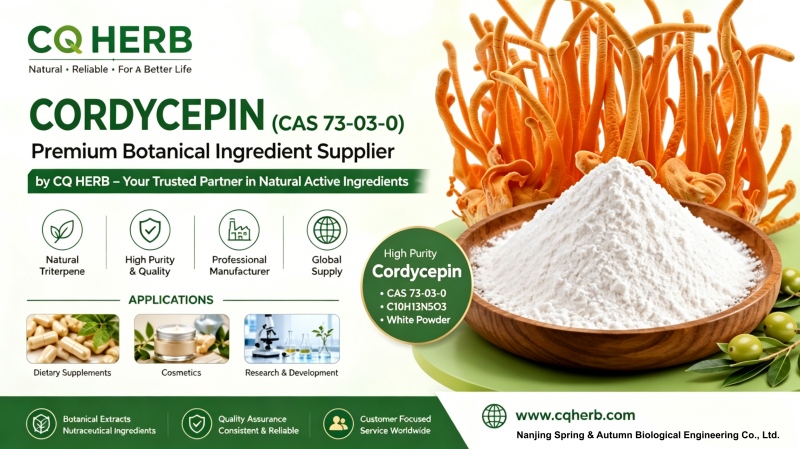
    CQ HERB Cordycepin 98% (CAS 73-03-0): High Purity Cordycepin Supplier & Manufacturer As interest in natural bioactive compounds continues to grow, Cordycepin (CAS 73-03-0) has become one of the most widely studied ingredients derived from Cordyceps militaris. CQ HERB is a professional supplier and manufacturer of high-purity Cordycepin, providing reliable ingredient solutions for nutraceutical, cosmetic, and scientific research applications worldwide. What Is Cordycepin? Cordycepin, also known as 3'-Deoxyadenosine, is a naturally occurring nucleoside compound primarily found in Cordyceps militaris, a medicinal mushroom that has been used and studied for centuries. Due to its unique chemical structure, Cordycepin has attracted increasing attention from researchers, product developers, and ingredient manufacturers. Product Information Item Specification Product Name Cordycepin CAS Number 73-03-0 Molecular Formula C10H13N5O3 Molecular Weight 251.24 Appearance White to Off-White Powder Purity 98% HPLC Source Cordyceps Militaris Brand CQ HERB About Cordyceps Militaris Cordyceps militaris is one of the most recognized medicinal fungi in the world and is considered an important natural source of Cordycepin. Compared with traditional fungal extracts, purified Cordycepin 98% offers greater consistency, standardized quality, and easier formulation for product developers. Today, Cordyceps militaris-derived ingredients are increasingly utilized in dietary supplements, nutraceutical products, and scientific research projects. Why Is Cordycepin Receiving Growing Attention? Researchers continue to investigate Cordycepin because of its unique chemical properties and natural origin. Current areas of scientific interest include: Natural nucleoside compounds Medicinal mushroom research Functional ingredient development Nutraceutical innovation Cosmetic ingredient exploration Biotechnology research As research progresses, Cordycepin remains one of the most important active compounds isolated from Cordyceps militaris. Applications of CQ HERB Cordycepin 98% Dietary Supplement Development Cordycepin is frequently evaluated as a high-value ingredient in dietary supplement formulations. Potential applications include: Capsules Tablets Powder blends Functional nutrition products Scientific Research High-purity Cordycepin is widely supplied for: Natural product research Mushroom-derived compound studies Analytical reference applications Biotechnology research projects Cosmetic Ingredient Development The cosmetic industry continues to explore naturally derived active ingredients. Cordycepin may be evaluated for use in: Premium skincare formulations Botanical cosmetic products Research-oriented cosmetic applications Why Choose CQ HERB Cordycepin? High Purity CQ HERB supplies Cordycepin 98% tested by HPLC to ensure product consistency and quality. Professional Manufacturing As a specialized botanical ingredient manufacturer, CQ HERB maintains strict production and quality control standards. Global Supply Capability We provide: COA Product Specifications Technical Documentation Batch Traceability Export Support Customer-Oriented Service CQ HERB works closely with customers worldwide to provide customized ingredient solutions and reliable supply support. Quality Standards at CQ HERB Quality is a core priority at CQ HERB. Our manufacturing and quality management process focuses on: Raw material verification Standardized production Analytical testing Batch consistency International documentation support These measures help ensure that customers receive dependable Cordycepin ingredients for their projects and formulations. How to Select a Reliable Cordycepin Supplier When sourcing Cordycepin bulk ingredients, buyers should evaluate suppliers based on: Product Quality HPLC purity verification Reliable specifications Stable supply capacity Manufacturing Experience Botanical extraction expertise Industry experience Quality management systems Technical Support COA availability Regulatory documents Responsive communication Choosing an experienced Cordycepin manufacturer can help streamline procurement and product development processes. Why Global Customers Choose CQ HERB CQ HERB specializes in botanical extracts, nutraceutical ingredients, and cosmetic raw materials. Our advantages include: Professional Cordycepin manufacturer International export experience Customized specifications Reliable quality control Dedicated customer support We are committed to helping customers develop innovative products based on high-quality natural ingredients. Frequently Asked Questions What is Cordycepin? Cordycepin is a naturally occurring nucleoside compound primarily derived from Cordyceps militaris. What is the CAS number of Cordycepin? The CAS number of Cordycepin is 73-03-0. What purity does CQ HERB offer? CQ HERB supplies high-purity Cordycepin 98% tested by HPLC. Is Cordycepin suitable for dietary supplement formulations? Cordycepin is commonly supplied as a raw material ingredient for nutraceutical and dietary supplement product development. Can CQ HERB provide technical documentation? Yes. We provide COA, specifications, and other technical documents upon request. Partner with CQ HERB If you are looking for a reliable Cordycepin supplier, Cordycepin manufacturer, or Cordyceps militaris extract specialist, CQ HERB is ready to support your sourcing and development needs. For quotations, specifications, and technical documentation, please contact CQ HERB through www.cqherb.com.
    Read More

leave a message

leave a message
If you are interested in our products and want to know more details,please leave a message here,we will reply you as soon as we can.
submit

home

products

WhatsApp

contact