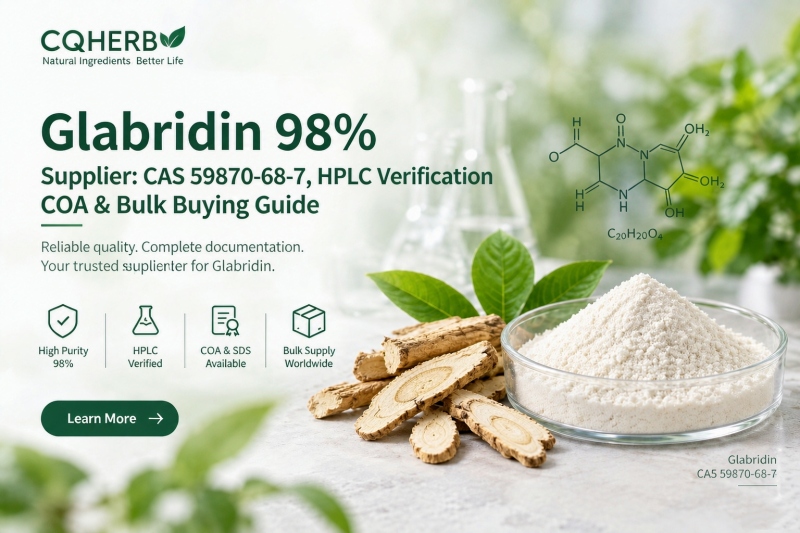
Glabridin 98% Supplier: CAS 59870-68-7, HPLC Verification & Bulk Buying Guide
Oct 30, 2026
Glabridin (CAS 59870-68-7) is a prenylated isoflavan purified from the root of Glycyrrhiza glabra (licorice). When sourcing Glabridin 98%, buyers should verify three things before placing an order: batch-specific HPLC chromatograms (not just a COA summary), botanical origin and extraction process documentation, and heavy-metal and residual-solvent data consistent with the destination market's cosmetic or research-use regulations. Reputable suppliers provide 20 g-scale samples with complete documentation before commercial quantities.
Key Takeaways
· Glabridin is the key purified isoflavan in licorice root; commercial grades range from standardized licorice extracts (10%–40%) to high-purity ≥98% HPLC material.
· "98% Glabridin" and "licorice extract standardized to 40% glabridin" are different products with different price structures — confirm which one you are comparing.
· Always request: batch COA, HPLC chromatogram, SDS, heavy metals, residual solvents, and botanical source statement.
· Glabridin is light- and oxidation-sensitive; packaging and storage conditions directly affect batch-to-batch consistency.
· Regulatory status differs by market and application — confirm the intended use (cosmetic ingredient, research compound) with your regulatory team before purchase.
1. Chemical Identity and Specifications
Item
Specification
Product Name
Glabridin
CAS Number
59870-68-7
Molecular Formula
C₂₀H₂₀O₄
Molecular Weight
324.37 g/mol
Botanical Source
Root of Glycyrrhiza glabra L.
Appearance
White to off-white crystalline powder
Purity
≥98% (HPLC)
Solubility
Soluble in ethanol, DMSO; poorly soluble in water
Documentation
COA, HPLC, SDS, TDS available per batch
Because Glabridin is a single purified compound rather than a standardized extract, buyers can verify identity and purity analytically with standard laboratory methods, which is one reason it is widely used in cosmetic raw-material and natural-product research programs.
2. Glabridin 98% vs. Standardized Licorice Extract: Know What You Are Comparing
A frequent source of confusion in licorice-derived quotations is the difference between purified Glabridin and standardized licorice extract:
Parameter
Glabridin 98% (purified compound)
Licorice extract (standardized, e.g. 40% Glabridin)
Composition
Single isoflavan compound
Complex extract with multiple licorice constituents
Purity basis
≥98% Glabridin by HPLC
Glabridin content standardized, balance is other extractives
Typical use
Cosmetic actives, analytical reference, research
Finished-product formulations, cost-driven applications
Price basis
Per-kilogram, purity-driven
Lower unit cost, higher inclusion rates
Analytical identity
Sharp single HPLC peak
Multiple-peak fingerprint
Before comparing quotations, confirm the basis: "98% Glabridin" and "40% Glabridin licorice extract" are not interchangeable, and neither price nor formulation math can be compared directly.
3. HPLC Verification: What a Valid COA Should Contain
When auditing a supplier's Certificate of Analysis for Glabridin 98%, check for the following:
1. Batch-specific data. The COA must reference the exact batch number you will receive. Template COAs without batch numbers are a warning sign.
2. HPLC method and chromatogram. Ask for the actual chromatogram, not only the purity figure. The report should state the column type, detection wavelength, and integration method.
3. Identity confirmation. For high-value shipments, IR or MS confirmation of structure adds assurance that the compound is Glabridin rather than a co-eluting peak.
4. Impurity profile. Residual licorice congeners (e.g., glabrene, liquiritigenin) and process-related impurities should be reported or stated as within specification.
5. Heavy metals and residual solvents. Results should align with the requirements of your destination market — for example, the technical documentation expectations for cosmetic raw materials in the EU or North America.
6. SDS and TDS. Safety data and technical data sheets should be current and consistent with the COA.
A practical approach used by many procurement teams: request a 20 g sample with full documentation, run independent HPLC verification at a third-party laboratory, then move to commercial quantities. CQ HERB supports sample evaluation with batch-specific documentation for this purpose.
4. Stability, Packaging and Storage
Glabridin is sensitive to light and oxidation. In practice, this affects bulk handling:
· Packaging: double-layer PE bags inside fiber drums for 1–25 kg quantities; sealed foil bags for smaller development batches.
· Storage: cool, dry, light-protected conditions; keep containers tightly closed.
· Shelf life: typically 24 months when stored as recommended; retest dates should appear on the COA.
· Formulation note: because solubility in water is low, formulators commonly work with ethanol-based or solubilized systems; discuss the intended formulation format with your supplier so the recommended grade and particle presentation match.
5. Intended Applications and Regulatory Context
Glabridin 98% is supplied for:
· Cosmetic raw-material development — as a botanical-derived active ingredient used by formulators in skin-care product development, where the finished product's claims must comply with local cosmetic regulations.
· Research applications — as a reference compound and research material in phytochemistry and natural-product studies.
Regulatory note: the permitted use, labeling, and claim language for Glabridin-containing products differ by market (cosmetic ingredient frameworks, ingredient nomenclature such as INCI, and local advertising rules). Buyers should confirm the intended use and destination-market requirements with their own regulatory team. CQ HERB supplies the ingredient together with technical documentation; the ingredient itself is not a finished product and carries no product claims.
6. Supplier Evaluation Checklist
Use this checklist when comparing Glabridin suppliers:
· Batch-specific HPLC chromatogram provided (not just a purity number)
· Botanical origin and extraction process described transparently
· Heavy metals and residual solvents reported
· SDS, TDS, and COA consistent with each other
· Sample policy: small-quantity samples available for third-party verification
· Traceable production information and stable multi-batch supply
· Export documentation experience for your destination market
· Responsive technical support (not only sales support)
Nanjing Spring & Autumn Biological Engineering Co., Ltd. (CQ HERB) supplies Glabridin 98% with batch-based quality documentation including COA, HPLC analytical data, SDS and TDS, and supports sample evaluation before bulk orders. Our quality management system is certified to ISO 9001.
7. Bulk Ordering Practicalities
· Sample stage: 20 g with full documentation for independent verification.
· Development batches: 1–5 kg, typically ex-stock or short lead time.
· Commercial quantities: 25 kg fiber drums; larger volumes scheduled against forecast.
· Shipping: export-standard packaging; documentation set provided per shipment.
· Lead time: confirm current stock and production schedule when requesting quotation.
FAQ
Q: What CAS number is Glabridin? A: Glabridin is CAS 59870-68-7, molecular formula C₂₀H₂₀O₄, molecular weight 324.37 g/mol.
Q: Is Glabridin the same as licorice extract? A: No. Glabridin is a single purified compound isolated from licorice root. Licorice extract is a complex botanical preparation that may be standardized to a defined Glabridin content.
Q: What purity grade should I buy? A: ≥98% HPLC is the common specification for cosmetic raw-material development and research use. Standardized licorice extracts (lower Glabridin content) are a separate product category with a different cost structure.
Q: Which documents should a Glabridin supplier provide? A: At minimum: batch COA, HPLC chromatogram, SDS, TDS, botanical source statement, and heavy-metal/residual-solvent data as applicable to your market.
Q: Can I get a sample before bulk purchase? A: Yes. CQ HERB provides sample quantities with batch-specific documentation so buyers can complete independent verification before commercial orders.
Q: How should Glabridin be stored? A: In cool, dry, light-protected conditions in tightly closed containers. Refer to the SDS and TDS for batch-specific guidance.
Read More
 English





 IPv6 network supported